Xatt l-Ahmar · Gozo
MV Karwela
The most dived wreck in Gozo, and deservedly: a fifty-metre ferry sitting dead upright on sand at forty metres with a staircase that every underwater photographer in the Mediterranean has shot.
Sea conditions
Excellent right now
Flat, sheltered and calm
Forecast for the site, updated 01:45 AM
- Waves
- 0.3 m
- from SE
- Wind
- n/a
- Swell
- 0.2 m
- 5 s period
- Sea temp
- 29 °C
Next 7 days
Exposed to wind and swell from: E (90°), SE (135°), S (180°), SW (225°). Sheltered from the north-westerly that shuts down most of Gozo, so this whole bay is the standard fallback in a blow. Easterly and southerly winds put swell straight into it and the rocky entry gets dangerous quickly. Currents on the wreck are usually negligible; visibility is typically twenty metres or better. Best season: April to November for warm water and the ladders being in place, though it dives all year when the wind sits in the north-west.
The dive
If somebody says they are diving a wreck in Gozo, this is almost certainly it. The Karwela went down in 2006 with buoyancy tanks lashed on to stop her repeating the Xlendi's embarrassment, and it worked: she landed square on her keel on clean sand, bow at about thirty-nine and stern at forty-one, with the top deck and the captain's cabin waiting for you at thirty.
That thirty-metre deck matters. It means you arrive at the wreck rather than plunging to it, and you can shape the dive sensibly: sweep the upper deck first, drop to the promenade level, then decide how deep you actually want to go. Large rectangles were cut along both sides of the first two decks before she was sunk, so there is light everywhere inside and the penetration feels less like a commitment and more like walking through a ruin.
The headline feature is the staircase in the middle of the ship, a wide curved flight running down to the lower deck with portholes throwing beams across it. Get there before the group behind you, keep your fins up, and it is one of the best photographs in Malta. There is a little silt and drifted sand on the lower deck, so it stays good only if everybody behaves.
Outside, three decks' worth of steel have been colonised properly in twenty years: bream and damsels in clouds, grouper in the shadows, the odd barracuda hanging off the stern. Divers once sank a Volkswagen Beetle onto her starboard deck by floating it out on barrels; nothing of it survives, which is a shame, but it remains the best story on the site.
- The staircase, lit through the portholes, and probably Malta's most photographed wreck detail
- Sitting perfectly upright, so the ship still reads as a ship
- Three decks with cut openings that make penetration bright and navigable
- Top deck at thirty metres, which gives you a sane way to shape the dive
- Closest of the Xatt l-Ahmar big wrecks to the shore entry
Typical plan
Off the ladders, down early and south-west over the plateau to the drop-off, then follow the slope until the superstructure rises at thirty. Work the top deck and the cabin, drop through to the staircase around thirty-six, run the promenade deck along the cut openings, then take the sand at the bow or stern at thirty-nine to forty-one for a couple of minutes. Around twenty minutes on the wreck at a thirty-three metre average is a normal recreational plan on nitrox 32 with a short deco stop, and the shallow reef on the way back is a comfortable place to spend it. Torch even in daylight, and file the staircase as a one-diver-at-a-time stop.
What the bottom looks like
- 1Shallow plateau and boulders off the entry7 m deep · 60 m out
- 2Reef drop-off, about forty metres short of the bow22 m deep · 160 m out
- 3Top deck and captain's cabin30 m deep · 200 m out
- 4The staircase down to the lower deck36 m deep · 240 m out
- 5Bow39 m deep · 275 m out
- 6Stern41 m deep · 330 m out
- 7Open sand around the hull41 m deep · 350 m out
Rocky plateau and Posidonia near shore, then a gentle sand slope that the hull rests squarely on.
Who you might meet
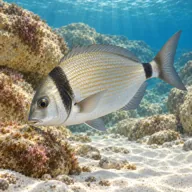
Two-banded seabream
Almost always · Sargu
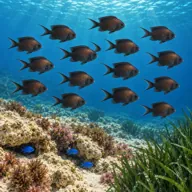
Damselfish
Almost always · Chromis chromis
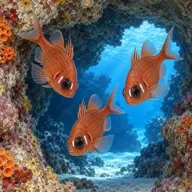
Cardinalfish
Almost always · Apogon imberbis · Inside the decks
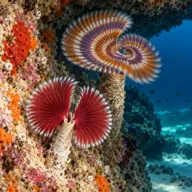
Tube worms, sponges and hydroids on the plating
Almost always
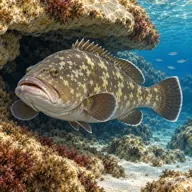
Dusky grouper
Often · Ċerna
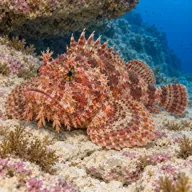
Scorpionfish
Often · Ċippullazza
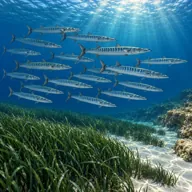
Barracuda
Sometimes · Sphyraena viridensis · Summer and autumn
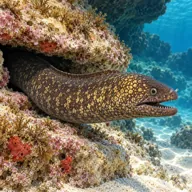
Moray eel
Sometimes · Morina
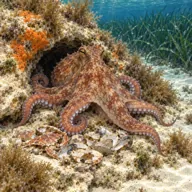
Octopus
Sometimes · Qarnita
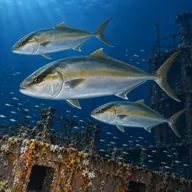
Amberjack
Sometimes · Aċċola · Summer
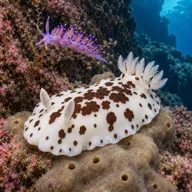
Nudibranchs
Sometimes · Spring
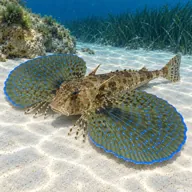
Flying gurnard on the sand
Lucky day · Dactylopterus volitans · Summer
Getting in and staying safe
Shore dive from Xatt l-Ahmar. Come down the narrow lane from Ghajnsielem below Mgarr; the track is rough and low cars have a hard time of it, though there is now a decent parking and kitting area at the bottom. Short walk down to the rocky shore and in off two short steel ladders, which are in place for the season and lifted out over winter. The bow is the closest of the three big wrecks to the entry, which is a large part of why it is the most dived. Boat dives are common too and save the walk. No toilets, no cafe, no shade at the site; the nearest of all three is back up in Mgarr or Ghajnsielem.
- Forty metres maximum, so decompression obligation on most realistic plans
- Penetration means an overhead environment even with cut openings; the staircase is a queue point
- Silt and drifted sand on the lower deck, easily ruined by one bad kick
- Narcosis at depth combined with the distraction of a photogenic wreck
- Surface swim out and the walk back up to the car in full kit
- Sharp cut steel edges around the openings
- Boat traffic overhead in summer; deploy a DSMB
- Ladders removed in winter, making the exit a scramble
A bit of history
Built in 1957 by Jos L Meyer in West Germany as the Frisia II, a 497 ton steel passenger ferry fifty metres long, rated for over eight hundred passengers and no cars at all. She became Nordpaloma in 1977, came to Malta in 1986 as the Karwela, and was bought by Captain Morgan Cruises in 1992 to run tourist trips around the Grand Harbour until she was retired in 2002. The Gozo Tourism Association scuttled her at Xatt l-Ahmar on 12 August 2006 alongside the Cominoland. Cassar Ship Repair stripped both vessels of hazardous material, taking eighteen tons of oil and fuel out of the Karwela alone. In a deliberate experiment she was left with her paintwork on while the Cominoland was stripped bare, to see which surface marine life would settle on faster.
Divers say
Sign in to rate this site and leave a note for the next diver.
- No reviews yet. First one gets bragging rights.
Further reading: Malta Dives: MV Karwela wreck · Wrecksite.eu: M/S Karwela · DiveWise Malta: MV Karwela · Calypso Sub Aqua Club: Karwela