Xatt l-Ahmar · Gozo
Hephaestus
Gozo's newest big wreck: a sixty-metre bunkering tanker that wrecked itself on Qawra Point in a storm, then got a second career on the sand at Xatt l-Ahmar. Deep, upright and still sharp-edged.
Sea conditions
Excellent right now
Flat, sheltered and calm
Forecast for the site, updated 01:45 AM
- Waves
- 0.3 m
- from SE
- Wind
- n/a
- Swell
- 0.2 m
- 5 s period
- Sea temp
- 29 °C
Next 7 days
Exposed to wind and swell from: E (90°), SE (135°), S (180°), SW (225°). Xatt l-Ahmar's usual story: sheltered from the north-westerly and therefore the first choice when Gozo's west and north coasts are unworkable, but closed out by anything from east through south. Currents on the wreck are usually light. Visibility on the sand is often twenty to thirty metres, which the depth and the size of the ship both make good use of. Best season: May to October for the warmest water and the ladders in place; diveable year round in northerly weather by boat.
The dive
The Hephaestus is the only one of the Xatt l-Ahmar wrecks that was already a wreck before anybody decided to sink her, and that history shows. She is a working tanker, not a converted passenger ferry, so the shapes are different: a long low deck line broken by pipework and valve clusters, accommodation and funnel aft, and an engine room that is the best part of the dive.
She sits upright on her keel on the sloping sand, and the numbers depend on where you are standing. The superstructure tops out in the mid thirties and the deepest point of the hull is down around forty-six or forty-seven metres. That is deeper than the Karwela and the Cominoland and firmly into technical territory for anything more than a quick look, which is why she has quietly become the Gozo wreck people train up for.
Large access holes were cut before she went down, including into the engine room, so penetration is possible for divers with the right cards and the right gas. It is still a young wreck by Mediterranean standards, though, which means clean steel, sharp cut edges and not much marine growth yet compared with the 2006 wrecks nearby. Give her another decade.
As a shore dive she is a serious undertaking: a long approach across the bay, down the drop-off, then a few minutes more out over the sand, and everything reversed at the end with decompression to pay. Most people who are sensible about it take the boat.
- Gozo's newest big wreck, scuttled in August 2022
- A real tanker layout: deck pipework, valve clusters and an accessible engine room
- Sixty metres of ship standing upright on clean sand
- The deepest of the four Xatt l-Ahmar wrecks, at forty-six to forty-seven metres
- A ship that wrecked itself on Qawra Point before it was ever intended as a dive site
Typical plan
Boat drop above the hull, or a long shore approach from the ladders across the bay and down the slope. Arrive on the superstructure in the mid thirties, run the deck aft to forward taking in the pipework, drop to the bow on the sand at forty-five for a short look, and keep any engine room penetration to a single brief, well-lit pass with a clear exit. Twenty minutes at a forty metre average is a substantial decompression dive: plan it on trimix or at minimum nitrox with a deco stage, and spend the ascent and stops back on the reef slope where there is something to look at.
What the bottom looks like
- 1Reef drop-off before the sand slope22 m deep · 200 m out
- 2Top of the superstructure, shallowest structure35 m deep · 275 m out
- 3Main deck with tanker pipework and valves38 m deep · 300 m out
- 4Cut access hole into the engine room41 m deep · 320 m out
- 5Bow section on the sand45 m deep · 360 m out
- 6Deepest point on the seaward side47 m deep · 400 m out
Sloping sand, clean and pale, with the reef and Posidonia plateau behind you on the way out and back.
Who you might meet
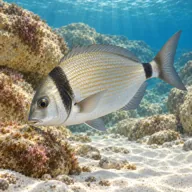
Two-banded seabream
Almost always · Sargu
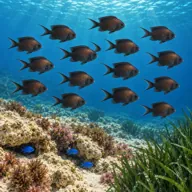
Damselfish
Almost always · Chromis chromis
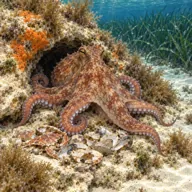
Octopus
Often · Qarnita
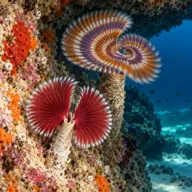
Early sponge and tube worm growth on the plating
Often
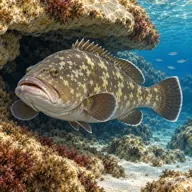
Dusky grouper
Sometimes · Ċerna
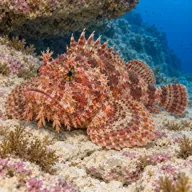
Scorpionfish
Sometimes · Ċippullazza

Cardinalfish in the shaded interior
Sometimes · Apogon imberbis
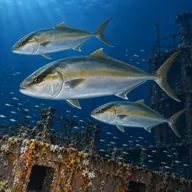
Amberjack
Sometimes · Aċċola · Summer

Barracuda
Sometimes · Sphyraena viridensis · Summer and autumn
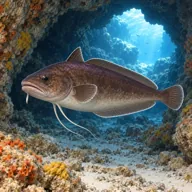
Forkbeard sheltering in the hull
Sometimes · Phycis phycis
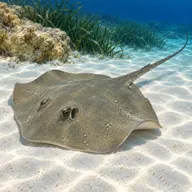
Common stingray on the sand
Lucky day · Dasyatis pastinaca
Getting in and staying safe
Shore dive from Xatt l-Ahmar or, more commonly for this one, a boat dive. The lane down from Ghajnsielem below Mgarr is narrow and rough; park and kit at the bottom, walk down to the rock and enter off the seasonal steel ladders. From there it is a long swim across the bay to the drop-off and several minutes more over the sand to the hull, so allow around twenty minutes each way and budget gas accordingly. Boat pick-up from Mgarr avoids both the swim and the climb back to the car, and given the decompression this dive usually carries, that is money well spent. No facilities at the site.
- Depth of thirty-five to forty-seven metres, a decompression dive on any realistic plan
- Long approach and return, with the exit at the end of a deco obligation
- Sharp cut steel and relatively fresh edges on a young wreck
- Engine room penetration is a true overhead environment needing wreck training and appropriate gas
- Silt and residual sediment inside the hull
- Narcosis and gas management on a big ship at depth
- Boat traffic overhead; deploy a DSMB before ascending
- Steep walk back up to the car with doubles or a rebreather
A bit of history
Built in 1965 at Lidköping in Sweden, 595 gross tons, just over sixty-one metres long with a beam of just under eight, and a single diesel good for eleven knots. She was working as a bunkering tanker off Malta when, on 10 February 2018, she was anchored near Is-Sikka l-Bajda a few kilometres offshore and began dragging in a heavy storm. She drove ashore on the rocks at Fra Ben near Qawra Tower at about quarter past six that morning. She was carrying no cargo and all seven crew got off safely. After temporary repairs she was pulled clear by two tugs on 15 August 2018 and towed to Marsa, where the damage proved too expensive to repair. Four years of debate later she was scuttled off Xatt l-Ahmar on 29 August 2022 as Gozo's fourth artificial reef, and the first there in sixteen years.
Divers say
Sign in to rate this site and leave a note for the next diver.
- No reviews yet. First one gets bragging rights.
Further reading: Wikipedia: MT Hephaestus · Malta Dives: Hephaestus wreck · Blue Hole Diving: MT Hephaestus · Times of Malta: Tanker wrecked in Qawra could become Gozo diving attraction · MSIU safety investigation into the grounding of MT Hephaestus