Xatt l-Ahmar · Gozo
Xatt l-Ahmar
Gozo's wreck yard and its bad-weather insurance policy in one bay: four scuttled ships on the sand, a boulder reef with caves above them, and shallow training water right at the ladders.
Sea conditions
Good right now
Some chop (0.4 m SSW)
Diveable for the rest of the day. Lowest point 78 around 17:00.
Forecast for the site, updated 12:44 PM · Models differ a little
Measured at Mġarr, Gozo (2.7 km away, 01:50 PM): 4 km/h from SSE, gusts 5. The next hours lean on it.
- Waves
- 0.4 m
- from SSW, biggest 0.7
- Wind
- 7 km/h
- N, gusts 13
- Swell
- 0.4 m
- 4 s period
- Sea temp
- 28 °C
- air 25 °C
Hour by hour
Next 7 days
Sunrise 06:48, sunset 19:04
Waves: Copernicus Med-Waves 4 km + MFWAM 8 km + EWAM 5 km + ECMWF WAM 9 km. Wind: ICON-2I 2 km + ECMWF IFS 9 km + ICON-EU 7 km + UKMO 10 km + ARPEGE 11 km. Read a few km out on the side the site is open to, then blended.
Exposed to wind and swell from: E (90°), SE (135°), S (180°), SW (225°). The definitive north-westerly refuge on Gozo, which is why the whole island's dive fleet turns up here on a blowy day. It closes out with easterly, south-easterly and southerly wind, when swell wraps into the bay and the ladder exit becomes the limiting factor. Currents are generally light to nonexistent and visibility is usually good, often twenty metres and better on the sand. Best season: Divable all year when the wind sits north-west; best from May to October for water temperature, with the ladders in place and the longest daylight.
Dives at Xatt l-Ahmar
MV Xlendi
Xatt l-Ahmar, Gozo
MV Karwela
Xatt l-Ahmar, Gozo
MV Cominoland
Xatt l-Ahmar, Gozo
Xatt l-Ahmar Bay
Xatt l-Ahmar, Gozo
Xatt l-Ahmar Reef
Xatt l-Ahmar, Gozo
Hephaestus
Xatt l-Ahmar, Gozo
The dive
Red Bay is the most useful dive site on Gozo. Not the prettiest, not the most dramatic, but the one that keeps a week of diving alive when the majjistral is blowing and every other coast is white. It faces south-east, tucked below Ghajnsielem near Mgarr, and it is sheltered from precisely the wind that closes everything else.
What it offers is a range you rarely find in one entry. Right in front of the ladders there is four to nine metres of rock, boulder and Posidonia that instructors use constantly and that makes a fine night dive. Swim south-west and the shelf tips into a drop-off and a boulder-strewn slope down to thirty, with caves, overhangs and resident grouper, which is a complete dive on its own.
And below that, on the sand, is the reason the bay is famous. Four ships lie in a rough line: the MV Xlendi, an eighty-metre ferry that rolled during her 1999 scuttle and settled upside down at forty-two; the MV Karwela, fifty metres, upright at forty and the most dived wreck on the island thanks to her staircase; the MV Cominoland, a converted 1942 minelayer at thirty-nine; and the MT Hephaestus, a sixty-metre tanker sunk in 2022 and the deepest of the lot at around forty-six.
All four are shore-divable if you are willing to swim and to manage gas properly, and all four are easier from a boat out of Mgarr. Between them you could spend a long weekend here without repeating yourself, which, given the bay is a rough track and two steel ladders, is a remarkable return.
- Four scuttled ships on one sand slope, from a 1942 minelayer to a 2022 tanker
- The Karwela staircase, the most photographed wreck detail in Malta
- A boulder reef with caves and grouper that stands up on its own merits
- Shallow, current-free training and night-diving water right at the entry
- The island's reliable answer to a north-westerly blow
Typical plan
Pick your dive by qualification. Beginners and classes stay inside the bay at five to twelve metres for an easy hour. Experienced divers run the reef drop-off at twenty to thirty and come back over the shelf. Deep divers take one wreck per dive: the Karwela is the shortest swim and the best value, the Cominoland the quietest, the Xlendi the strangest, the Hephaestus the most demanding. For any of the wrecks, plan nitrox or trimix with a staged ascent, put your deco time on the reef slope rather than in blue water, and remember the walk back up to the car at the end.
What the bottom looks like
- 1Shallow boulders and training ground by the ladders5 m deep · 40 m out
- 2Posidonia beds on the shelf8 m deep · 100 m out
- 3Reef drop-off along the southern edge22 m deep · 185 m out
- 4Caves and overhangs in the boulder slope26 m deep · 215 m out
- 5MV Karwela, upright at forty metres40 m deep · 290 m out
- 6MV Cominoland, upright to the east39 m deep · 320 m out
- 7MV Xlendi, inverted to the west42 m deep · 330 m out
- 8MT Hephaestus, the deepest of the four46 m deep · 400 m out
Limestone slab and boulder with Posidonia close in, then a clean pale sand slope carrying all four wrecks.
Who you might meet
Almost always
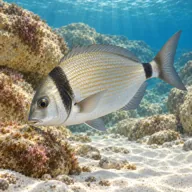
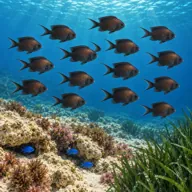
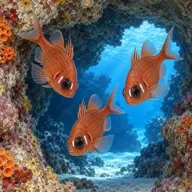
Often
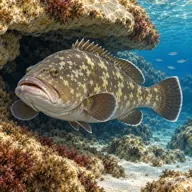
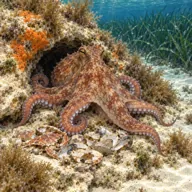
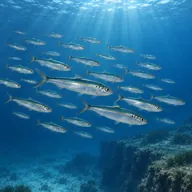
Sometimes
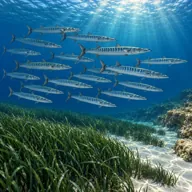
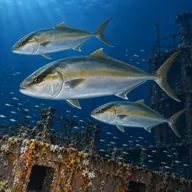
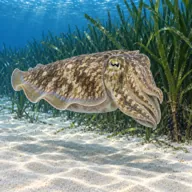
Marked ones can hurt you. What they do and what to do about it is under Getting in and staying safe.
Getting in and staying safe
Reached by a narrow, winding and rough lane down from Ghajnsielem, just below Mgarr. Ground clearance helps and a four-wheel drive is a comfort, though the parking and kitting area at the bottom has been improved. From there it is a short walk down to the rocky shore and in off two steel ladders, which are installed for the diving season and lifted out in winter. Nothing at the site: no toilets, no cafe, no shade, no fresh water. Mgarr and Ghajnsielem are a few minutes back up for food, fills and facilities. Most centres also run boats from Mgarr harbour, which makes the wrecks considerably less work.
- Four wrecks at thirty-nine to forty-seven metres, all decompression dives in practice
- Long swims out and back if diving the wrecks from shore
- Overhead environments inside three of the wrecks; the Xlendi should not be entered at all
- Slippery rocky entry, with the ladders removed over winter
- Rough access track and a climb back to the car in kit
- Boat traffic from Mgarr harbour and dive boats working the wrecks
- Depth creep from the reef towards the wrecks, since you can often see them
- Sea urchins and sharp rock in the shallows
Marine life to respect
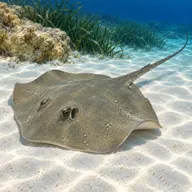
Common stingray · Boll Can hurt you
Whips a barbed tail if stepped on or cornered. Stay off the sand and give it room.
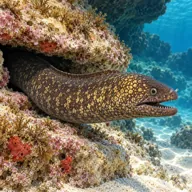
Mediterranean moray · Morina Can hurt you
Bites hard if a hand goes into its hole. Keep hands out of cracks and never feed one.
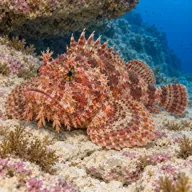
Red scorpionfish · Ċippullazza Can hurt you
Venomous spines, and it sits still on the rock. Look before you kneel or hold on; hot water if stung.
A bit of history
The name translates as the red shore. The bay's diving story begins in 1999, when the Gozo Tourism Association scuttled the retired Gozo Channel ferry MV Xlendi outside it as the island's first artificial reef. That sinking went wrong and she landed inverted, so when the MV Karwela and MV Cominoland followed on 12 August 2006 they were fitted with buoyancy tanks and lift bags and both landed upright. Cassar Ship Repair cleaned all the vessels of oil and hazardous material beforehand. The programme resumed after a sixteen-year pause when the tanker MT Hephaestus, grounded at Qawra in a storm in February 2018 and later refloated, was scuttled here on 29 August 2022.
Divers say
Sign in to rate this site and leave a note for the next diver.
- No reviews yet. First one gets bragging rights.
Further reading: Malta Dives: Xatt l-Ahmar · Calypso Sub Aqua Club: Xatt l-Ahmar · Atlantis Gozo: Xatt l-Ahmar · SDI/TDI: Trip report, Xatt l-Ahmar, Gozo