Malta
HMS Olympus
An Odin-class submarine lying upright and largely whole at around a hundred and fifteen metres, holding the worst British submarine loss of the war. Eighty nine died, nine swam seven miles home.
Sea conditions
Good right now
Some chop (0.5 m E)
Forecast for the site, updated 01:48 AM
- Waves
- 0.5 m
- from E
- Wind
- n/a
- Swell
- 0.5 m
- 5 s period
- Sea temp
- 29 °C
Next 7 days
Exposed to wind and swell from: N (0°), NE (45°), E (90°), SE (135°), S (180°). Deep offshore ground east of Valletta, so nothing protects you. A flat sea and a stable forecast are not optional here. Gregale conditions cancel it outright. On a good day visibility on the wreck is thirty metres or more, but the light is very low at that depth and you will want serious primary lighting to appreciate anything. Best season: June to September, when long calm windows make a multi hour dive defensible..
The dive
Olympus is the dive that quiets a boat down on the way out. She sits upright on the sand, eighty six metres of submarine, remarkably intact for something that was mined. Her deck gun is still there, trained upward, and her hatches stand open where men got out. It is not a subtle site and it does not need to be.
The damage is on the starboard side, which is where the mine caught her, and the rest of the boat reads as a submarine should: the long pressure hull, the casing, the conning tower rising off it. A memorial plaque left by a diving team marks the spot. She is a designated war grave under Heritage Malta and the rules are absolute. No penetration, no touching, no souvenirs. Those open hatches are not an invitation.
Practically this is a big trimix day. A hundred and fifteen metres gives you perhaps fifteen minutes to take in a boat you cannot see the ends of at once, followed by a couple of hours coming back up. Most people do one long slow pass from the conning tower forward and settle for that, then come back another year for the rest.
- An almost complete Odin-class submarine sitting upright on the sand
- Deck gun still in place, aimed at a sky she never signalled
- The heaviest British submarine loss of the war, and a survival story that beggars belief
- Only found in 2011, so still a relatively young site
- Memorial plaque left by the divers who located her
Typical plan
Hypoxic trimix or a well shaken down rebreather. Twelve to fifteen minutes at a hundred and fifteen metres, down the shot to the conning tower, forward past the gun to the bow, back along the casing, then up the line. Two hours or more of staged decompression on intermediate trimix, fifty percent nitrox and oxygen. Full redundancy, bail-out planning for the whole ascent, and a team that has done this depth together before.
What the bottom looks like
- 1Conning tower and open escape hatches105 m deep · 20 m out
- 2Deck gun, still trained upward108 m deep · 28 m out
- 3Bow section and forward casing112 m deep · 60 m out
- 4Mine damage on the starboard side114 m deep · 80 m out
- 5Flat sand around the hull115 m deep · 100 m out
Flat, fine sand at the edge of the shelf, undisturbed and easy to silt out if you drop your fins.
Who you might meet
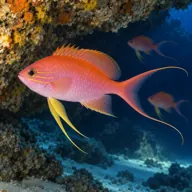
Swallowtail sea perch
Almost always · Pixxiroża
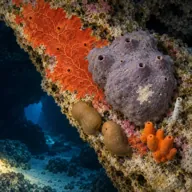
Encrusting sponges
Almost always · Sponża
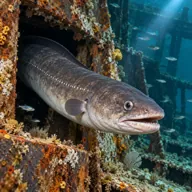
Conger eel
Often · Gringu
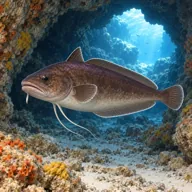
Greater forkbeard
Often · Lipp tal-qawwi
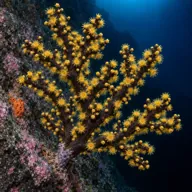
False black coral
Sometimes
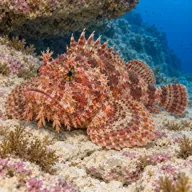
Red scorpionfish
Sometimes · Ċipullazza
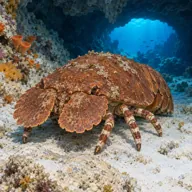
Slipper lobster
Sometimes · Ċikala
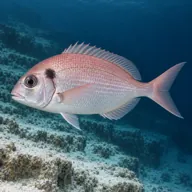
Blackspot seabream
Sometimes · Bażuga
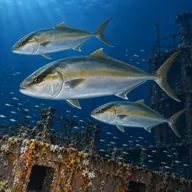
Greater amberjack
Lucky day · Aċċola · Late summer
Getting in and staying safe
Boat only, through a Heritage Malta registered technical centre with a licensed boat. Booking runs through the Underwater Cultural Heritage Unit system, which also notifies the chamber and other stakeholders, and you sign the conditions beforehand. Expect a shot line placed for you, a live boat throughout, oxygen and a proper surface team. Plan a whole day around it. Nothing about this one is casual.
- A hundred and fifteen metres: hypoxic trimix or closed circuit only, two hours plus of decompression
- Designated war grave with eighty nine men still aboard
- Open hatches that tempt penetration, which is forbidden and would be lethal
- Mine damage means torn, unstable plate on the starboard side
- Fishing line and nets snagged on the conning tower and periscopes
- Offshore position with shipping traffic and no shelter
- Long deco in open water, needing a marker and a boat that will follow it
A bit of history
Olympus was an Odin-class submarine built by William Beardmore and commissioned in 1930, eighty six and a half metres long on a six metre beam, displacing over seventeen hundred tons on the surface. She served on the China Station through the thirties, then with the 8th Flotilla at Colombo, and came to the Mediterranean in 1940 where she ran the Magic Carpet supply trips into besieged Malta. On 8 May 1942 she sailed for Gibraltar carrying not just her own crew but the survivors of the submarines Pandora, P36 and P39, all of them bombed out at Malta. A few kilometres out she struck a mine. Of ninety eight men aboard only nine lived, and they did it by swimming roughly seven miles back to the island. It remains the heaviest British submarine loss of the Second World War. The wreck was not confirmed until an Aurora Trust team relocated her in 2011, with the find announced in January 2012. She was opened to permitted diving on 1 May 2019.
Divers say
Sign in to rate this site and leave a note for the next diver.
- No reviews yet. First one gets bragging rights.
Further reading: Heritage Malta: HMS Olympus · Wikipedia: HMS Olympus (N35) · uboat.net: HMS Olympus · The Past: HMS Olympus, a tale of tragedy and heroes