🐟 Fish · Zeus faber
John Dory
Pixxi San Pietruin Maltese, also Ħuta San Pietru, San Pietru
A thin oval with a thumbprint and a trapdoor mouth
Meet the John Dory
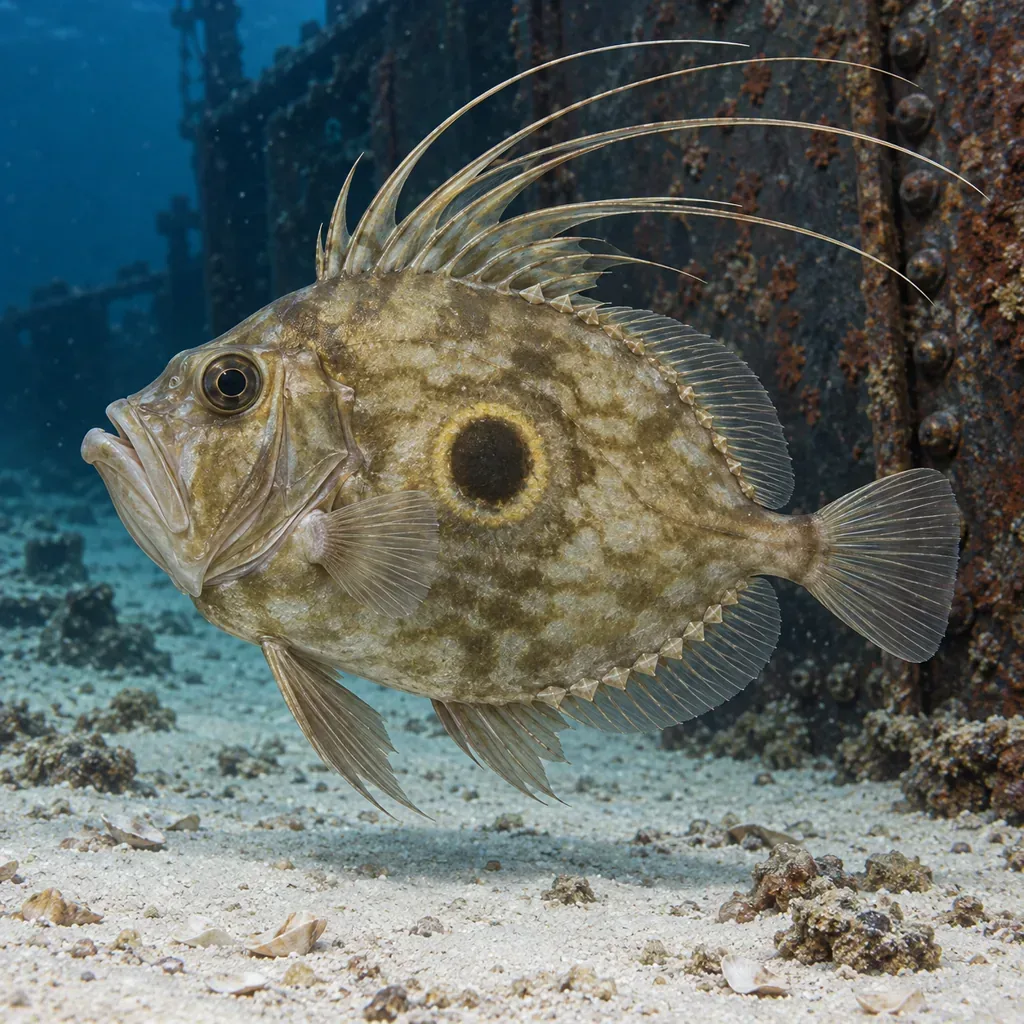
The John Dory is one of the strangest fish a diver can meet in Malta. Seen from the side it is a tall, almost circular olive-grey to yellowish-brown plate, finely marbled, with a dark round spot ringed in pale yellow in the middle of each flank. Seen from the front it nearly disappears, because the body is only a couple of centimetres thick. Long trailing spines run along the top of the first dorsal fin, and there is a row of bony bucklers along the base of the dorsal and anal fins. The mouth is the real machinery: it shoots forward into a wide tube in a fraction of a second, sucking in a whole small fish. Maltese fish are usually 25 to 45 cm and the species can reach 90 cm.
It is a slow, solitary, ambushing predator of sand, mixed bottom, deep reef edges and wrecks, officially from 5 to 400 metres but usually deeper than 50. Divers here find them on the sandy plains and hull shadows around the Um El Faroud, P29, P31, Rozi and Imperial Eagle, at the foot of deeper reef slopes, and occasionally very shallow in winter. They stalk prey edge-on, turning that knife-thin profile towards the target so that almost nothing is visible until the mouth fires.
The dark flank spot carries the story behind both the English and the Maltese names: it is said to be the thumbprint of Saint Peter, left when he took a coin from the fish's mouth. Pixxi San Pietru is a well-known and highly regarded fish on the Maltese market, usually landed from deeper water.
When to look: All year, with more shallow-water sightings in the cooler months from late autumn to early spring, and usually as a single fish rather than a group.
Diving with them
- Look for a vertical grey slab hanging motionless just off the bottom; a John Dory almost never looks like a fish until it turns side-on.
- Scan the shaded sand beside wreck hulls and the base of deeper reef slopes, where they hover over an ambush position.
- They tolerate a slow approach better than almost any other large fish, so move at half speed and stop often.
- Shoot from the side for the golden-ringed spot and the trailing dorsal filaments, then take one head-on frame to show how thin it is.
- Do not crowd one that is stalking prey; a hunting Dory drifts imperceptibly and will simply turn away if you cut its line.
Can it hurt you?Harmless
Harmless to divers. The dorsal spines and the bony bucklers along the fin bases are sharp enough to scratch a careless hand, but the fish neither bites nor stings and never approaches people aggressively.
Easily confused with
- Flying gurnard, also odd-shaped but bottom-walking with huge blue-spotted pectoral fans and no flank spot
- Wide-eyed flounder and other flatfish, which lie flat on the sand rather than standing upright and thin
- Amberjack or dentex seen head-on, which are thin in profile too but never carry the golden-ringed dark spot
Where to meet them: 7 sites
Small World
Malta
Further reading: FishBase: Zeus faber (size, depth range, solitary ambush biology) · GBIF vernacular names for Zeus faber, Maltese entries (Pixxi San Pietru, Ħuta San Pietru) · Wikipedia: John Dory (IUCN Data Deficient listing, Saint Peter thumbprint tradition)