🐟 Fish · Atherina hepsetus
Sand smelt
Kurunellain Maltese, also Kurunetta, Makku
Shimmering shoals in every shallow bay
Meet the Sand smelt
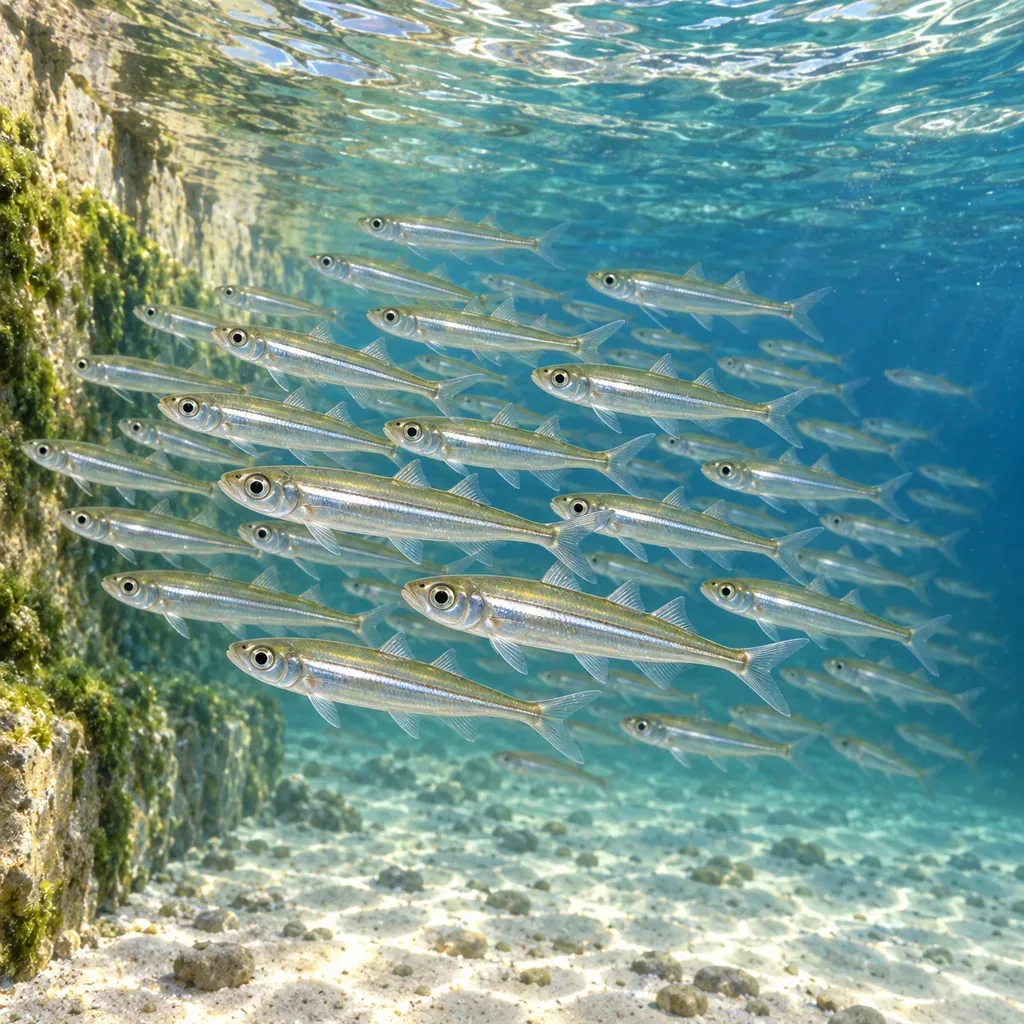
A slim, semi-transparent little fish with a big eye, a small upturned mouth and a bright silver stripe running the length of each flank, edged above with a thin dark line. The back is a pale translucent olive, the belly almost see-through, and there are two small separate dorsal fins. Most are 8 to 15 cm, rarely up to 20.
They are the first fish most people meet in Malta, because they live in exactly the places people swim: the top metre or two of sheltered bays, under jetties and pontoons, along harbour walls and around the ladders at Sliema, Xlendi, St Peter's Pool and Ghadira. They hang in dense shoals near the surface picking plankton out of the water, part as you swim through, and close up behind you. At night they drop closer to the bottom.
A note on the name. Maltese speakers often call small silvery whitebait makku, but strictly makku is the tiny transparent goby, Aphia minuta, and by extension any fine whitebait fry sold for fritters and soups. The proper Maltese name for the adult sand smelt is kurunella, with kurunetta also in use. Malta has two similar atherinids: the bigger-scaled Atherina boyeri of brackish and very sheltered water, and this one, Atherina hepsetus, of the open coast.
When to look: All year in sheltered water, with the biggest surface shoals through summer and autumn when the sea is warm and calm.
Diving with them
- Best seen snorkelling or in the first minutes of a shore dive, they live above you, not below
- Stop finning and let the shoal reassemble, it will close around you within seconds
- Shoot upward into the surface light for silhouettes and surface reflection, they are almost impossible to light flatly
- Watch for garfish, small barracuda or amberjack driving a shoal against a harbour wall, a good show in a metre of water
- They are the classic bait shoal, so their presence near a jetty is a reasonable clue that predators are working the area
- Useful for a safety stop, hanging at five metres under a jetty with a shoal overhead makes three minutes pass quickly
Can it hurt you?Harmless
Harmless in every way. No spines, no venom, and far too small to do anything but swim around you.
Easily confused with
- Big-scale sand smelt (Atherina boyeri), which is shorter and deeper-bodied with noticeably larger scales and prefers brackish and very sheltered water
- Juvenile grey mullet, which are chunkier, blunt-headed and graze the surface film and algae on walls
- Sardine and anchovy juveniles, which are less transparent and shoal out in open water rather than hugging the shore
- Transparent goby (Aphia minuta), the true makku, which is almost glass-clear and much smaller
Where to meet them: 1 sites
Daħlet Qorrot
Gozo
Further reading: FishBase: Atherina hepsetus, Malta country page with Maltese names · Wikipedia: Mediterranean sand smelt · Il-Miklem: Makku, the Maltese term for whitebait (Aphia minuta) · Fishipedia: sand smelt biology and behaviour