🐟 Fish · Chelon labrosus
Grey mullet
Mulettin Maltese, also Mulett kaplat, Kaplat
The harbour grazer with the rubber lip
Meet the Grey mullet
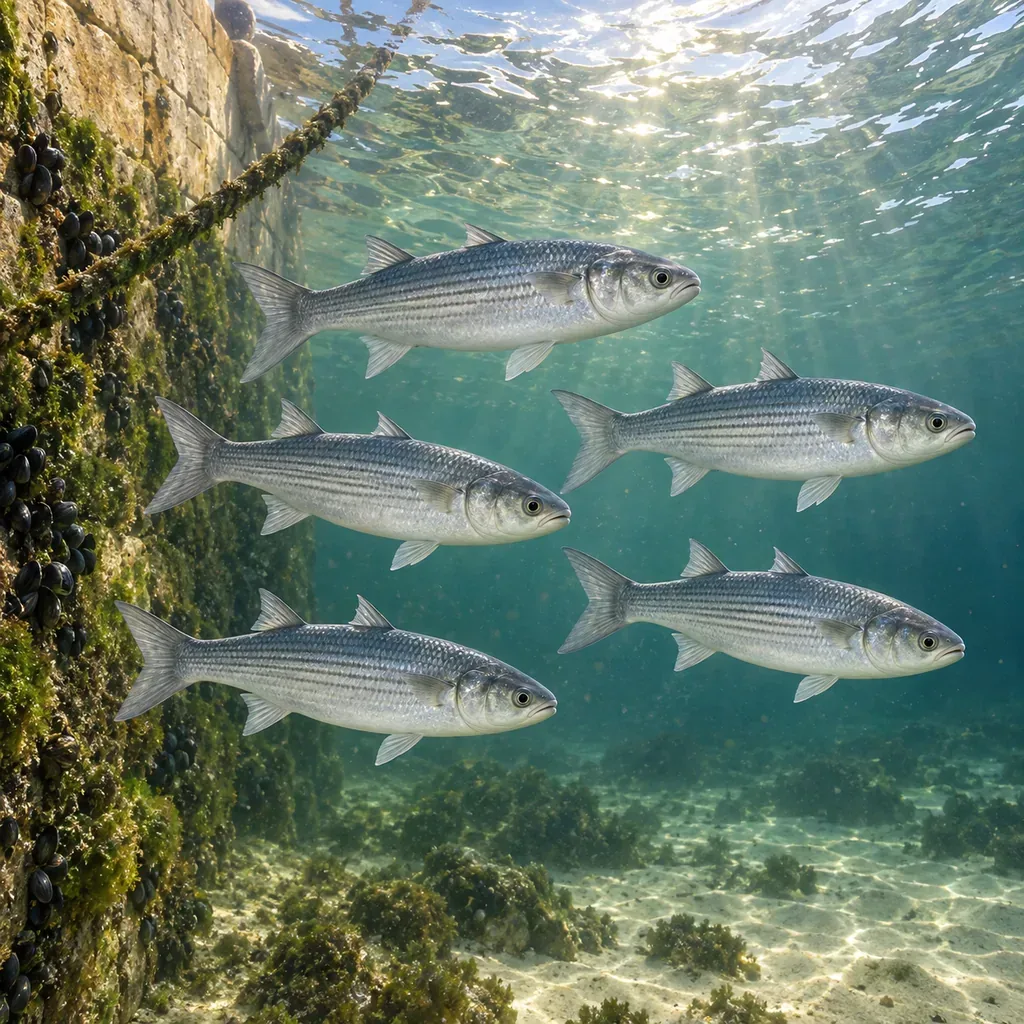
Grey mullet are the silver, torpedo-shaped fish that hang just under the surface in every Maltese harbour, marina and sheltered creek. The thicklip grey mullet, Chelon labrosus, is the species most often close inshore: a blunt-headed, heavy-bodied fish, dark blue-grey on the back with silver flanks marked by faint grey longitudinal lines, two widely separated dorsal fins, and the thick upper lip that gives it its name. Other species share the same water and are easy to confuse, particularly the flathead grey mullet Mugil cephalus, known locally as mulett kbir, which is larger with a fatty eyelid, and the golden grey mullet Chelon auratus, or lostru, which has a distinct golden blotch on the gill cover. Common sizes are 30 to 50 cm, with a ceiling around 75 cm.
They graze rather than hunt, scraping films of algae, diatoms and organic sediment off rock, ropes, hulls and harbour walls, and processing it with a muscular gizzard-like stomach. Divers meet them in the top few metres at places like Marsamxett and Grand Harbour slipways, Marsascala, Marsaxlokk, Birżebbuġa, Mġarr harbour in Gozo and around any boat mooring, usually as a loose, nervous shoal that drifts away and then reforms behind you.
Around Malta the grey mullet also carries a small cultural stigma. Because harbour fish feed on sediment and outfall-rich silt, mullet caught inside the harbours are often regarded as second-rate eating, while fish taken from clean open coast are a normal food fish.
When to look: All year in harbours and creeks, most visible in the top three or four metres in calm conditions and often densest in late summer and autumn.
Diving with them
- Look up, not down: mullet sit between the surface and about five metres, often silhouetted against the light.
- They are skittish and break formation the moment you turn towards them, so swim past on a steady line and let the shoal reform around you.
- Watch a harbour wall or a mooring line to see them grazing, tilting side-on to scrape the algal film off vertical surfaces.
- Visibility in Maltese harbours is poor and boat traffic is real, so use a surface marker buoy wherever you dive among moored boats.
- They are excellent silhouette and surface-light subjects, especially in shallow water on a bright day.
Can it hurt you?Harmless
Completely harmless. Grey mullet are algae and detritus grazers with soft mouths and no spines or venom.
Easily confused with
- Flathead grey mullet (Mugil cephalus), the mulett kbir, which is bigger with a transparent fatty eyelid covering much of the eye
- Golden grey mullet (Chelon auratus), the lostru, which shows a clear golden-yellow patch on the gill cover
- Boxlip mullet (Oedalechilus labeo), smaller with an even more swollen, fringed upper lip
- Bogue and sand smelt shoals near the surface, which are slimmer, smaller-headed and have a single dorsal fin
Where to meet them: 1 sites
Further reading: FishBase: Chelon labrosus (size, depth, diet, schooling behaviour) · GBIF vernacular names for Chelon labrosus, Maltese entries (Mulett, Mulett kaplat, Kaplat) · Il-Miklem Maltese thematic dictionary: mullet names (Mulett kbir, Lostru, Mulett ta' xofftu)