Wied iż-Żurrieq · Malta
Blue Grotto Caves
Malta's most photographed sea caves, and almost nobody dives them. Shallow, luminous, and squarely in the path of every tourist boat on the south coast.
Sea conditions
Good right now
Some chop (0.5 m ESE)
Forecast for the site, updated 01:45 AM
- Waves
- 0.5 m
- from ESE
- Wind
- n/a
- Swell
- 0.5 m
- 5 s period
- Sea temp
- 29 °C
Next 7 days
Exposed to wind and swell from: SW (225°), S (180°), SE (135°), W (270°), NW (315°). Shallow and open, so it is the first site in the area to become undiveable and the last to come back. The tourist boats themselves are a useful gauge: if the luzzus are not running, neither should you be. A northwesterly wraps swell round the island onto this coast, and anything southerly hits it directly. Best season: Late May to September, early morning, when the light in the caverns is at its best and before the boat traffic builds. Flat calm only..
The dive
The Blue Grotto is a run of sea caverns under a natural limestone arch about a kilometre east of the Żurrieq inlet, and the reason it is famous is honest: when morning sun bounces off the pale sand outside and back up into the chambers, the water goes an improbable electric blue and the walls throw back reds, oranges and greens. The Maltese name, Taħt il-Ħnejja, simply means under the arch.
As a dive it is shallow, a handful of metres in the caverns themselves and not much beyond about 14 outside, with plenty of nooks, side chambers and boulder-filled gullies to potter around. Cardinalfish hang in the darker corners, and the light shafts through the cave mouths are the whole point.
The catch is logistical rather than underwater. Getting here on your own steam means a swim of roughly forty minutes each way from the valley, which turns a pleasant shallow dive into an endurance event. Coming by boat means sharing the water with the luzzus that ferry tourists in and out all day, in numbers. And because it is shallow and faces open sea, any swell at all turns the caverns into a surge chamber.
Which is why this is a site almost every dive centre looks at, shrugs, and books Um El Faroud instead. If you do get a flat, early, quiet morning here, take it.
- The famous blue light, seen from underneath instead of from a boat
- A natural arch and a string of connected caverns to explore
- Shallow enough for a very long, relaxed dive
- Rarely dived, so you will have something almost nobody else has
- Filfla on the horizon on the surface interval
Typical plan
Boat drop at the cave mouths on a flat early morning. Work through the caverns in the shallows with a torch, never far from daylight, then swing out along the cliff at 10 to 14 metres and drift back over the boulders and pale sand. Sixty minutes plus is realistic given how shallow it is, and air is fine. A DSMB up the moment you leave the rock, because the boats will not be looking for you. If you insist on swimming from the valley, treat it as a long surface swim out and back with a shallow dive in the middle, and only in flat water.
What the bottom looks like
- 1The natural arch, Taħt il-Ħnejja3 m deep · 15 m out
- 2Main grotto chamber5 m deep · 35 m out
- 3Side caverns along the cliff10 m deep · 85 m out
- 4Collapsed blocks outside the cave mouths13 m deep · 130 m out
- 5Pale sand that bounces the light back in14 m deep · 160 m out
Pale sand and collapsed limestone blocks outside the caverns, bare rock and rubble inside.
Who you might meet

Cardinalfish
Almost always · Re tat-trilji

Mediterranean damselfish
Almost always · Kaħlija
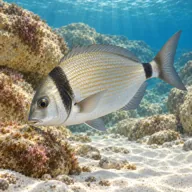
Two-banded bream
Almost always · Sargu
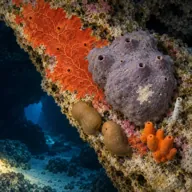
Encrusting sponges
Almost always · Sponża

Salema
Often · Sallura
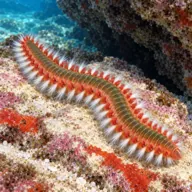
Bearded fireworm
Often · Busuf · summer
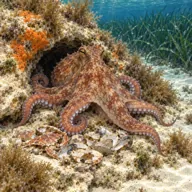
Common octopus
Sometimes · Qarnit
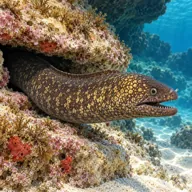
Mediterranean moray
Sometimes · Morina
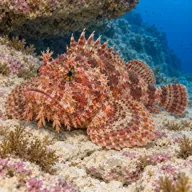
Scorpionfish
Sometimes · Skorfna
Getting in and staying safe
Realistically, boat. Tourist luzzus run from Wied iż-Żurrieq quay on calm days, and a dive boat can drop you at the mouth of the caverns. Shore access means entering at the quay and swimming east for around forty minutes, which is only sensible in perfect conditions with a strong team and a plan for the return leg. There is a viewing platform on the road above the grotto, but it is a cliff, not an entry point. All facilities, parking, cafes and toilets are back at Wied iż-Żurrieq.
- Very heavy tourist boat traffic, propellers at the surface, DSMB essential
- Surge in the caverns with even a small swell
- Long swim from the valley if not diving from a boat
- Overhead environment, torch each even in daylight caverns
- No shore exit anywhere near the site
- Shallow depth plus surge means contact with rock and urchins
- Mauve stinger jellyfish in spring and autumn
A bit of history
The caverns were cut by the sea into Upper Coralline limestone, working along joints and bedding planes in the cliff, and the arch that gives the place its Maltese name is the last stage before a roof gives way. Malta has watched that happen: the Azure Window at Dwejra on Gozo, the same kind of feature at a later stage of its life, collapsed into the sea in a storm in March 2017. The Blue Grotto has been a tourist boat destination since the 1950s, and the site has appeared in films and television including Troy. It looks out across open water to Filfla, the uninhabited islet that was used as a naval bombing range until 1971 and is now a nature reserve.
Divers say
Sign in to rate this site and leave a note for the next diver.
- No reviews yet. First one gets bragging rights.
Further reading: Wikipedia: Blue Grotto, Malta · Malta Dive Sites: Blue Grotto Caves · PADI: Wied iz-Zurrieq (Blue Grotto) dive site