Reqqa Point · Gozo
Bottleneck Cave
A natural rock shaft that takes you in at 37 m and lets you out at the foot of the cliff near 58 m. It is a geology dive first and a fish dive a very distant second, and it belongs to trimix divers only.
Sea conditions
Excellent right now
Flat, sheltered and calm
Forecast for the site, updated 01:33 AM
- Waves
- 0.4 m
- from ESE
- Wind
- 7 km/h
- SSW, gusts 14
- Swell
- 0.3 m
- 5 s period
- Sea temp
- 28 °C
- air 27 °C
Next 7 days
Sunrise 06:47, sunset 19:06
Exposed to wind and swell from: W (270°), NW (315°), N (0°), NE (45°). Reqqa faces the open north, so anything with north in it shuts the site down and a leftover swell from a blow two days earlier will still make the exit ledge a washing machine. A light southerly with a flat sea is the window you want. Visibility is often superb, thirty metres and more, because there is nothing but deep water upstream. Best season: May to October, with late September and October usually giving the calmest northern days and water still holding warmth down to about 25 m. Winter dives happen but need a settled spell and a hard look at the swell forecast..
The dive
Reqqa Point is the blunt little spur at the very top of Gozo, and most divers who go there are heading for Billinghurst Cave or the grouper-haunted reef. Bottleneck sits on the western flank of the same headland and asks a lot more of you. You follow the reef out and down until the rock opens into a hole barely wider than a diver in twin sets, and then the hole becomes a shaft roughly five metres across that simply drops.
Inside, the walls close around you in a cylinder. Torchlight picks out crack after crack packed with shrimp, their eyes throwing back the beam like scattered glitter. The floor arrives at about 58 m as a patch of coarse sand tilted gently seaward, and from there a low tunnel runs out to the base of the cliff. Coming out of that tunnel into open blue water with the reef wall soaring above you is the moment the whole dive is built around.
What there is not, is life. A grouper may drift past the shoulder of the reef on the way down and a few cardinalfish hover in the gloom, but the shaft itself trades biology for architecture. Bring the biggest light you own and a buddy who has been there before, because there is no natural light at the bottom and no quick way up.
Bottom line: gorgeous, serious, and utterly unforgiving of a casual gas plan.
- Dropping into a five metre wide rock cylinder and watching the daylight shrink to a coin
- Shrimp packed into every crack in the shaft walls
- The low tunnel that fires you out at the base of the Reqqa cliff
- Looking up through open water at the headland from nearly 60 m
- Visibility that regularly runs past thirty metres
Typical plan
Trimix dive, nothing less. A common run is a twenty minute swim out along the reef on a travel mix, a descent into the shaft mouth at 37 m, five to eight minutes in the cylinder down to the 58 m floor, then the tunnel out and a slow drift back along the cliff base while you begin the ascent. Bottom time of fifteen to twenty minutes at an average of 37 m with a max of 58 m buys you roughly thirty five to fifty minutes of staged decompression on 50 percent and oxygen, so plan a total runtime of eighty to ninety minutes. Twin sets plus two deco stages, three lights, and a deployed SMB before you leave the wall.
What the bottom looks like
- 1Reqqa wall running west from the point18 m deep · 60 m out
- 2Reef shoulder above the shaft30 m deep · 95 m out
- 3Bottleneck entrance, about one diver wide37 m deep · 110 m out
- 4Cylindrical shaft roughly 5 m across47 m deep · 116 m out
- 5Sandy shaft floor with shrimp-filled cracks58 m deep · 120 m out
- 6Low exit tunnel to the cliff base56 m deep · 132 m out
- 7Gently sloping sand at the foot of the wall54 m deep · 160 m out
Hard Coralline limestone reef and vertical rock, with a thin layer of coarse sand on the shaft floor and on the slope outside the exit tunnel.
Who you might meet
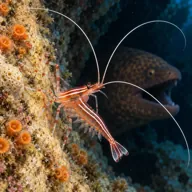
Cleaner and rock shrimps
Almost always · Gamblu
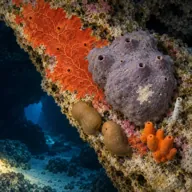
Encrusting sponges
Almost always · Sponża
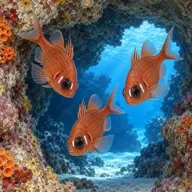
Mediterranean cardinalfish
Often · Re tat-trilji
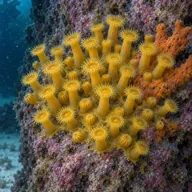
Yellow cluster anemone
Often
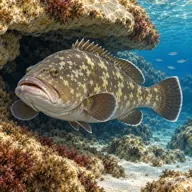
Dusky grouper
Sometimes · Cerna
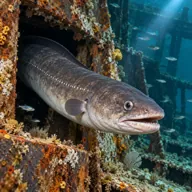
Conger eel
Sometimes · Gringu
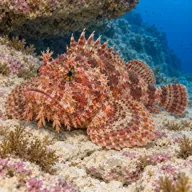
Scorpionfish
Sometimes · Skorfna
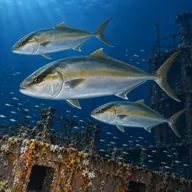
Amberjack passing in the blue
Sometimes · Accola · Late summer
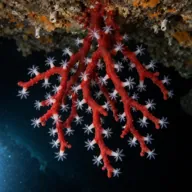
Red coral
Lucky day · Qroll ahmar
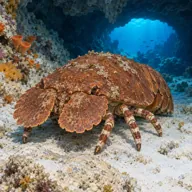
Slipper lobster
Lucky day · Cikala
Getting in and staying safe
Drive through Zebbug and take the lane that runs down towards Reqqa Point, then the last stretch of rough track to the parking area on the headland. From there it is a short but awkward carry over sharp, pitted limestone to the entry ledge, which is genuinely unpleasant in bare feet and worse with doubles and stages. A ladder is sometimes bolted at the usual entry, but do not count on it being there. There are no toilets, no shade and no facilities of any kind on the point. Marsalforn is the nearest place for fills, food and a shower, about fifteen minutes by car. A boat drop is much kinder on the knees if your centre offers it, and several tech operators run Reqqa that way.
- Depth well beyond recreational limits, with narcosis and a mandatory decompression obligation
- Overhead environment with no direct ascent from the shaft floor
- Entrance at 37 m is tight, roughly one diver at a time in twins
- No natural light below the shaft mouth, so a primary and two backups are not optional
- Monofilament and lost tackle on the reef above, courtesy of the anglers on the point
- Sharp, slippery limestone at the entry and exit ledge
- North coast swell makes exit the hardest part of the day
- Long, heavy carry from the parking area with technical kit
A bit of history
No wreck and no legend here, just water and time. Reqqa Point is Upper Coralline Limestone, the hard cap rock that armours most of Gozo's northern coast, and the shaft is a solution feature: rainwater worked its way down joints in the rock over tens of thousands of years, back when sea level sat far lower than it does now. When the Mediterranean refilled after the last glacial maximum, the drowned plumbing became a dive site. The headland above has been a favourite of local fishermen for generations, which is why so much monofilament ends up on the reef.
Divers say
Sign in to rate this site and leave a note for the next diver.
- No reviews yet. First one gets bragging rights.
Further reading: Visit Gozo, Bottleneck Cave · Calypso Sub Aqua Club, Reqqa Point · Atlantis Gozo, Bottleneck Cave · Divers Guide, Bottleneck Cave · Malta Dives, Bottleneck Cave