Gozo
Ras il-Kanun
A headland on Gozo's north coast where the rock breaks open into a big cave, with boulders, swim-throughs and a wall running out into deeper water. Usually dived together with the Cathedral Cave next door.
Sea conditions
Excellent right now
Flat, sheltered and calm
Forecast for the site, updated 01:33 AM
- Waves
- 0.4 m
- from ESE
- Wind
- 7 km/h
- SSW, gusts 14
- Swell
- 0.3 m
- 5 s period
- Sea temp
- 28 °C
- air 27 °C
Next 7 days
Sunrise 06:47, sunset 19:06
Exposed to wind and swell from: NW (315°), N (0°), NE (45°), W (270°). This is the exposed side of Gozo. Anything from west through north through northeast closes it, and the northwest in particular makes the cave mouth dangerous. Dive it in settled southerly weather, when the water here is usually glassy and very clear. Best season: June to October, when southerly and light winds dominate. Winter northwesterlies rule it out for long stretches..
The dive
Ras il-Kanun is the blunt headland just east of Wied il-Għasri, and it is better known by the name of the hole in it: Għar il-Qamħ, the cave of wheat, which opens northwest into the prevailing weather. The dive is a mix of everything the north coast does well. Sunlit shallows over broken rock, a scatter of large boulders with swim-throughs between them, a cavern entrance to poke into, and a wall that runs out and down past thirty metres for anyone who wants depth.
The honest verdict from divers who know the area is that it is good but not the best thing within swimming distance. The Cathedral Cave, whose domed chamber and enormous air pocket sit a short way along the same coast, tends to steal the dive. Most people treat Ras il-Kanun as the outbound or inbound leg of a Cathedral dive rather than as a destination on its own, and that is a sensible way to do it: two very different pieces of terrain in one dive.
Taken on its own terms there is plenty to like. The boulders hold octopus and moray, the swim-throughs are short and well lit, and the wall edges bring you into blue water where bigger fish pass. Visibility on this coast is often excellent because there is nothing sandy nearby to cloud it.
One caveat that matters more here than at most Gozitan sites: the cave mouth faces northwest, straight into the direction that generates the worst sea on this coast. On the right day it is beautiful. On the wrong one it is not diveable at all.
- Għar il-Qamħ, a big cave mouth cut into the headland
- Short, well-lit swim-throughs between huge boulders
- Wall dropping past thirty metres for a deeper leg
- Pairs perfectly with the Cathedral Cave next door
- North coast clarity on a settled day
Typical plan
Boat drop or swim out from Wied il-Għasri, then work along the headland at eight to twelve metres, visiting the cave mouth with a torch and threading the swim-throughs between the boulders. Drop along the wall to twenty or twenty-five metres for the middle of the dive, turn on half gas, and come back shallow over the rock, finishing with a long, bright safety stop at five or six metres. Air on a single is enough, nitrox 32 is nicer if you plan to spend time at twenty-five plus. Most divers link it with the Cathedral Cave in the same dive, so plan gas for the whole route, not just this half.
What the bottom looks like
- 1Għar il-Qamħ cave mouth in the headland5 m deep · 25 m out
- 2Boulder field below the headland9 m deep · 80 m out
- 3Short swim-throughs between the blocks13 m deep · 130 m out
- 4Wall running out from the point19 m deep · 190 m out
- 5Steeper section heading past 30 m27 m deep · 270 m out
- 6Sand and rubble at the base33 m deep · 340 m out
Broken coralline limestone and big fallen boulders close to the headland, grading to a rubble and sand slope further out.
Who you might meet
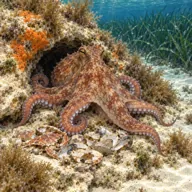
Common octopus
Almost always · Qarnit
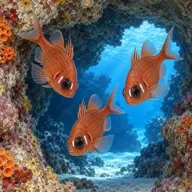
Cardinalfish
Almost always · Sultan iċ-ċawl
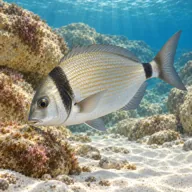
Two-banded seabream
Almost always · Sargu
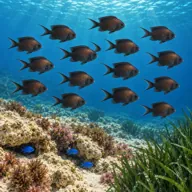
Damselfish
Almost always · Kaħlija
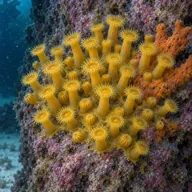
Golden zoanthids
Almost always
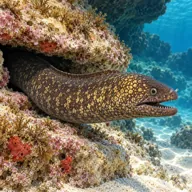
Mediterranean moray
Often · Morina
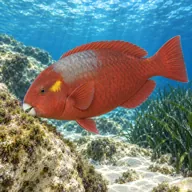
Mediterranean parrotfish
Often · Marzpan
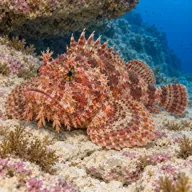
Scorpionfish
Often · Ċippullazza
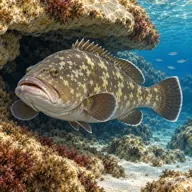
Dusky grouper
Sometimes · Ċerna
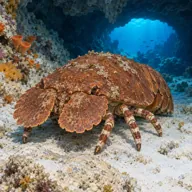
Slipper lobster
Sometimes · Ċikala
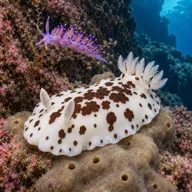
Nudibranchs
Sometimes · Spring
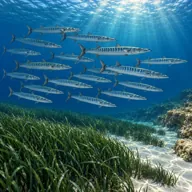
Barracuda
Lucky day · Lizz · Late summer
Getting in and staying safe
Shore access is possible but not casual. The usual approaches are the ladder at Għar il-Qamħ on the headland, or parking at the head of Wied il-Għasri and walking down the flight of steps into the gorge, then swimming out along the inlet to reach open water. Either way it is a carry over rough ground and a swim before the dive properly begins, so most people do it on a boat drop instead, which is also how the dive centres run it. Parking at Wied il-Għasri is limited and there are no facilities at either entry.
- Cave mouth faces northwest, so surge builds fast with any northerly swell
- Overhead environment inside the cavern: torch, line awareness and a buddy plan
- Exposed north coast with no easy exit once you are round the headland
- Steep steps and rough ground on the shore approach with kit
- Boat traffic in summer
- Depth on the outer wall passes 30 m
- Slippery ladder and rock at the water's edge
A bit of history
The cave name, Għar il-Qamħ, translates as cave of wheat, one of several Gozitan coastal caves whose names hint at storage or smuggling in the days when grain moved by small boat. The headland is Upper Coralline Limestone, the same hard cap rock that forms the cliffs along the whole north coast, and the caves and swim-throughs are the product of wave action working along joints and softer bands in it. The much larger Cathedral Cave nearby is the showpiece result of the same process.
Divers say
Sign in to rate this site and leave a note for the next diver.
- No reviews yet. First one gets bragging rights.
Further reading: MaltaDives, Ras il-Kanun, with diver reviews · Atlantis Gozo, Cathedral Cave and Għasri Valley · Gozo Aqua Sports, Cathedral Cave access notes · Dive Systems Malta, Cathedral Cave