🐟 Fish · Pterois miles
Devil firefish
Gorgeous, venomous and new to Maltese water
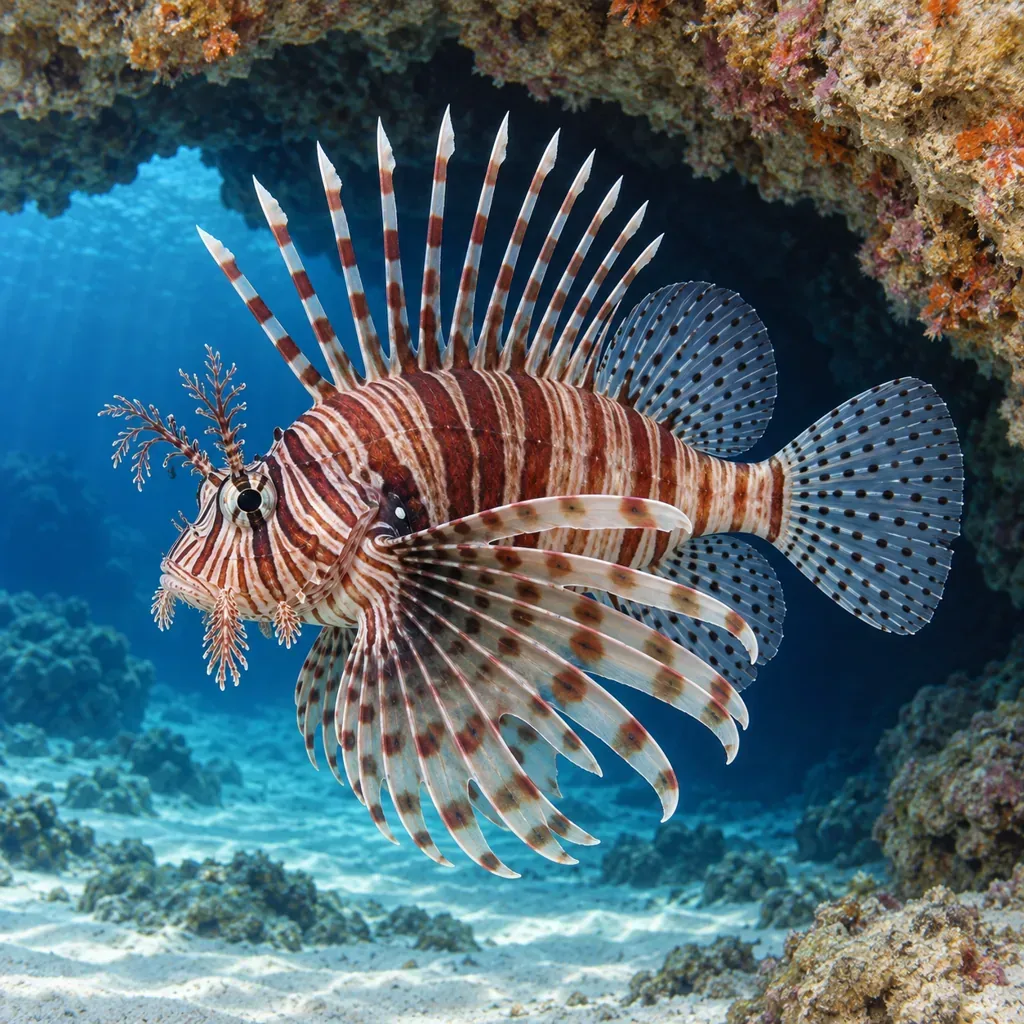
Meet the Devil firefish
Unmistakable and genuinely beautiful: a deep, compressed body banded in red-brown, maroon and cream, an ornate head with feathery tentacles above the eyes and below the mouth, and enormous fan-shaped pectoral fins spread like wings. Behind and above them stands a crest of long, thin, separated dorsal spines. In total the fish carries eighteen venomous spines, thirteen dorsal, three anal and two pelvic. Most are 20 to 30 cm; the maximum is about 43 cm.
It hunts by hanging in the water with the pectoral fans spread, herding small fish into a corner and then engulfing them with a sudden gulp. It is most active around dawn and dusk and often rests by day under overhangs, inside wrecks and in crevices, sometimes head-down against the rock. In the Mediterranean it has been recorded from the surface to 80 m and beyond, with most diver records between 5 and 30 m on rocky reef, wrecks and coralligenous ground.
It is an invader, and a very recent one for Malta. Pterois miles entered the Mediterranean through the Suez Canal, exploded across the eastern basin from 2016 onwards, and after years of unconfirmed local reports it was formally confirmed in Maltese waters on 30 June 2026, when a recreational angler landed one at Miġra l-Ferħa on Malta's western coast and researchers with the Spot the Alien Fish campaign identified it. Whether a breeding population establishes here is exactly what local scientists are now watching, and diver reports matter.
When to look: Any time of year if one is present, most active at dawn and dusk, and tucked under overhangs or inside wreck structure during the day.
Diving with them
- Keep a clear arm's length or more, and never reach into an overhang or wreck opening without looking first
- Be especially careful with hands and knees when steadying yourself, most stings are contact injuries, not attacks
- It does not flee like other reef fish, so it is on you to give way, not the other way round
- Photograph it, note the site, depth and date, and report it to the Spot the Alien Fish citizen science campaign
- Do not try to spear, catch or handle one, that is where nearly every serious envenomation comes from
- Brief buddies and students before the dive if lionfish have been reported at the site, and carry a plan for hot water back on the boat
Can it hurt you?Medically serious
The eighteen fin spines deliver a potent venom through a puncture wound, and a sting causes immediate severe pain out of all proportion to the wound, with swelling, and sometimes nausea, sweating, dizziness, numbness and, rarely, breathing difficulty or collapse. It is not aggressive and it will not chase a diver, but it also will not move out of your way, so the danger is brushing or grabbing it.
First aid: Get the casualty out of the water immediately and watch for fainting. Remove any spine fragments with tweezers, allow a small puncture to bleed for a moment, and wash with clean fresh water. Immerse the affected limb in hot water, as hot as can be tolerated without scalding and no hotter than about 45 C, for 30 to 90 minutes, topping it up as it cools; have an uninjured person test the temperature first, because venom-induced numbness makes scalding easy. Give simple painkillers, keep the limb still and elevated afterwards, and get the casualty to a doctor or emergency department: all lionfish stings need a medical check for retained spines, tetanus cover and infection, and any sign of breathing difficulty, chest pain, widespread rash or collapse is a 112 emergency.
Easily confused with
- Large-scaled scorpionfish (Scorpaena scrofa), the Maltese ċippullazza, which is also venomous but squat, warty and mottled, without the long separated spines or the fan pectorals
- Black scorpionfish (Scorpaena porcus), smaller, darker and equally well camouflaged against rock
- Red lionfish (Pterois volitans), which is not established in the Mediterranean, and is essentially impossible to separate underwater
- Flying gurnard, which also spreads huge pectoral fins but is blue-spotted, walks on the bottom and has no venomous crest
Where to meet them: 1 sites
Further reading: MaltaToday: first confirmed devil firefish in Maltese waters, 30 June 2026 · FishBase: Pterois miles, size, depth and venom note · NeoBiota: lionfish (Pterois miles) in the Mediterranean, review and invasion front · Divers Alert Network: lionfish stings in divers and first aid · University of Malta: native predators of invasive lionfish