Gozo
Ulysses Cave
A big cavern in the cliff north west of Xlendi, a boulder slope beneath it, and a small cave with a freshwater spring that turns the water to shimmering haze as you swim through it.
Sea conditions
Excellent right now
Flat, sheltered and calm
Forecast for the site, updated 01:33 AM
- Waves
- 0.3 m
- from SE
- Wind
- 8 km/h
- SSW, gusts 14
- Swell
- 0.2 m
- 5 s period
- Sea temp
- 28 °C
- air 27 °C
Next 7 days
Sunrise 06:47, sunset 19:06
Exposed to wind and swell from: SW (225°), W (270°), NW (315°). West facing, so anything with west in it puts swell straight onto the cliff and into the cave mouth. It is comfortable in an easterly and usually current free. Visibility typically runs twenty to forty metres. Afternoon sun lights the cavern mouth better than the morning, and if you are only going to do one dive here, make it the late one. Best season: May to October. The freshwater effect is most obvious in spring and after wet winters, when the water table is high, so late April and May are a quiet favourite..
The dive
Ulysses Cave earns its reputation on one detail. Set into the rock is a small cave, its mouth wide enough for two divers side by side, and inside it fresh groundwater seeps out of the limestone and floats over the salt water. The result is a wobbling, oily-looking layer that blurs everything above it and a noticeable change in temperature as you cross it. Divers who have done it a hundred times still stop and grin.
The rest of the dive is a pleasant west coast cruise. A large cavern is carved into the vertical cliff face where the boat drops you, and from there a slope of boulders and broken rock runs down. There is plenty of structure to work along, and the range is generous: you can potter at ten to fifteen metres or drop to forty five if your plan allows.
Inside the cave the walls carry green and purple algae, golden zoanthids, bath sponges and yellow cluster anemones, and scorpionfish sit perfectly still on the ledges waiting for you to not notice them. Fish numbers overall are modest, which locals put down to how heavily this stretch has been fished over the years. What the site lacks in fish it makes up in texture, and it is a favourite for night diving for exactly that reason.
Easy, scenic, and with one properly memorable party trick.
- Swimming through a freshwater layer inside a sea cave and feeling the temperature change
- A big cavern mouth in the cliff to start the dive on
- Green and purple algae, golden zoanthids and sponges under torchlight
- Depth range from ten to forty five metres, so it suits almost any plan
- One of Gozo's better night dives
Typical plan
Drop at the cavern, follow the boulder slope down to a turn depth of twenty five to thirty metres for most recreational plans, then work back up to the small cave at around twelve metres and take turns going in two at a time to cross the freshwater layer. Finish shallow along the rock. Roughly fifty minutes on a single 12 or 15 litre, air or nitrox 32, average depth about eighteen metres, torch required. Keep the cave visit for the end so any silt you stir costs nobody else the view.
What the bottom looks like
- 1Large cavern cut into the vertical cliff3 m deep · 8 m out
- 2Small cave with the freshwater spring, fits two divers12 m deep · 30 m out
- 3Boulder slope below the cliff16 m deep · 45 m out
- 4Rock face continuing into deeper water32 m deep · 95 m out
- 5Deep boulders at the usual turn point45 m deep · 140 m out
Boulders and broken rock all the way down, with sand collecting between blocks and a soft silt layer on the floor of the small cave.
Who you might meet
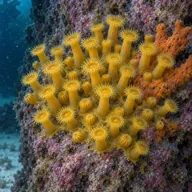
Yellow cluster anemone
Almost always
Golden zoanthids
Almost always
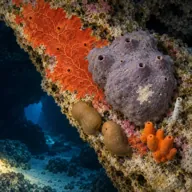
Bath and encrusting sponges
Almost always · Sponża
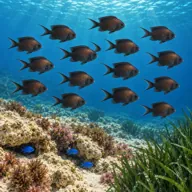
Mediterranean damselfish
Almost always · Kahlija
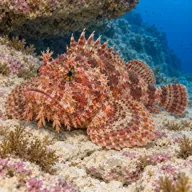
Scorpionfish
Often · Skorfna
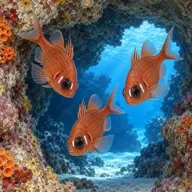
Mediterranean cardinalfish
Often · Re tat-trilji
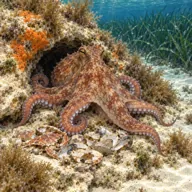
Common octopus
Sometimes · Qarnit
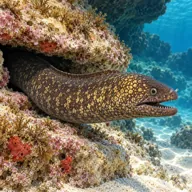
Moray eel
Sometimes · Morina
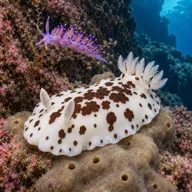
Nudibranchs
Sometimes · Spring
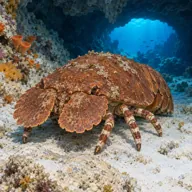
Slipper lobster on a night dive
Sometimes · Cikala
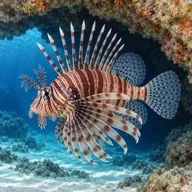
Devil firefish, the invasive lionfish
Lucky day
Getting in and staying safe
Boat only, a short run from Xlendi and a longer one from Mgarr. There are no permits and no fees. Skippers hold off the cliff or tie temporarily rather than anchoring. There is no shore exit along this stretch, so everything happens from the boat. Xlendi itself has parking, cafes, toilets, dive centres and fills, and is the natural base for a two dive morning taking in Ulysses and one of the neighbouring reefs. Night dives here are popular and worth arranging in advance.
- Overhead rock in the small cave, with room for only two divers at a time
- Haloclines that make buoyancy references and visibility briefly unreliable
- Silt on the cave floor
- Depth available well past forty metres on the boulder slope, so set a hard turn depth
- Surge against the cliff when any westerly swell is running
- Discarded fishing line and nets on a heavily fished stretch of coast
- Night diving here needs redundant lights and a clear boat recall plan
A bit of history
The name is a nod to Gozo's claim on Homer. The island has long been identified with Ogygia, where the nymph Calypso kept Odysseus, or Ulysses in the Roman telling, for seven years, and Calypso's Cave above Ramla Bay carries the same story on the other side of the island. There is no evidence connecting this particular sea cave to the myth beyond the name, but the freshwater spring inside it is a genuine piece of Gozo hydrology: rainwater percolating through the Upper Coralline Limestone and emerging where the perched water table meets the sea.
Divers say
Sign in to rate this site and leave a note for the next diver.
- No reviews yet. First one gets bragging rights.
Further reading: Divers Guide, Ulysses Cave · Malta Dives, Ulysses Cave · DiveBoat Malta, Ulysses Cave