A long, straight cave running about a hundred and twenty metres into the Dwejra wall from an entrance near twenty five metres, with an air pocket at the back and the exit in sight the whole way.
 Cave
 Wall
Sea conditions
Stay dry right now
Sea is up (5.1 m WNW) · Fresh WNW wind (42 km/h) · Gusts to 61 km/h
Done for today. Tomorrow: not looking good. Best it gets is 5 at 17:00: Sea is up (1.9 m WNW)
Forecast for the site, updated 19:45 · Models disagree
Measured at Mġarr, Gozo (14.5 km away, 20:29): 36 km/h from WNW, gusts 41. The next hours lean on it.
- Waves
- 5.1 m
- from WNW, biggest 8.5
- Wind
- 42 km/h
- WNW, gusts 61
- Swell
- 0.4 m
- 11 s period
- Sea temp
- 22 °C
- air 19 °C
Hour by hour
Next 7 days
 0 5.2 m
59 W
 0 4.9 m
53 WNW
25 1.2 m19 W
 81 0.4 m
17 ESE
 99 0.4 m
17 E
73 0.4 m23 NE
76 0.4 m21 ESE
Sunrise 06:26, sunset 17:06
Waves: Copernicus Med-Waves 4 km + MFWAM 8 km + EWAM 5 km + ECMWF WAM 9 km. Wind: ICON-2I 2 km + ECMWF IFS 9 km + ICON-EU 7 km + UKMO 10 km + ARPEGE 11 km. Read a few km out on the side the site is open to, then blended.
Exposed to wind and swell from: W (270°), NW (315°), SW (225°), N (0°). Deep enough inside to be untroubled by swell, but everything about getting there is exposed to the west and northwest. Flat water only, both for the swim or boat ride and for the pickup. Best season: June to September, when the surface is most reliably calm for the transit.
The dive
Barba means beard in Maltese, and the shaggy shape of the entrance is supposedly the reason for the name. The other name, the 200m Tunnel, is straightforwardly wrong: the cave is long, around a hundred and twenty metres, but it does not go through and it is not two hundred.
What it is instead is one of the more atmospheric swims on this coast. The mouth sits at roughly twenty five metres in a vertical wall. Inside, the passage runs dead straight, so the blue rectangle of the exit stays visible behind you the whole way in, which makes it far less intimidating than the numbers suggest. There is an air pocket towards the back where you can surface, although surfacing in a sealed pocket is a stunt rather than a plan.
There are actually two caves along this stretch, known locally as L-Għar tal-Barba and L-Għar in-Niexef, and the longer one is the beard. Getting there is the real problem: it is about two hundred metres north of the Inland Sea tunnel exit, which is a long way to swim on top of a deep cave dive.
Most people solve that with a scooter or by hiring one of the small boats from the Inland Sea for a drop off, then either getting picked up round the reef or diving back south and calling in at Whale Cave on the way.
- A hundred and twenty metre straight cave with the exit in view throughout
- Air pocket near the back, a curiosity rather than a plan
- Quiet stretch of wall that hardly anyone dives
- Combine with Whale Cave on the way back to the Inland Sea
- Dramatic bearded entrance at twenty five metres
Typical plan
Boat drop outside the cave, descend the wall to the entrance at about twenty five metres, then swim in along one side keeping your fins off the floor and the exit light behind you. Turn on thirds at the latest. Back out, work south along the wall in the low twenties, look into Whale Cave if gas allows, and either meet the boat or continue to the Inland Sea tunnel. Nitrox 32 and twin torches at minimum, and the passage deserves cave or at least cavern training before you commit to it.
What the bottom looks like
- 1Vertical reef wall on the approach20 m deep · 70 m out · under the boat
- 2Mouth of Tal-Barba, the beard25 m deep · 100 m out · 30 m from the boat
- 3Straight passage running inwards, exit always visible22 m deep · 180 m out · 110 m from the boat
- 4Air pocket near the back of the cave20 m deep · 215 m out · 145 m from the boat
- 5Wall continuing south towards Whale Cave and the Inland Sea Tunnel30 m deep · 300 m out · 230 m from the boat


Rock and fine sediment along the cave floor, with bare limestone wall and boulders outside the entrance.
Who you might meet

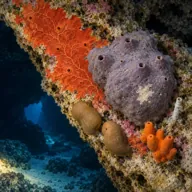
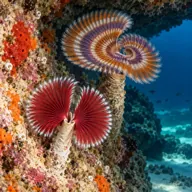
Sometimes
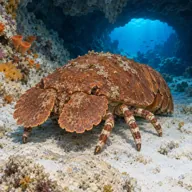
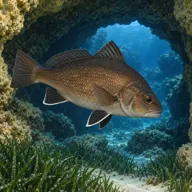
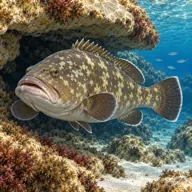
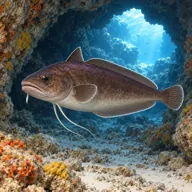
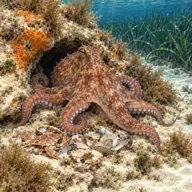
Marked ones can hurt you. What they do and what to do about it is under Getting in and staying safe.
Getting in and staying safe
No dedicated entry. Practical options are a boat drop from the Inland Sea, where the local boatmen will run you out and collect you, an underwater scooter, or a very long fin from the Inland Sea tunnel exit north along the wall. Whichever you pick, you park at the Inland Sea car park and kit up by the boathouses, where the cafes, toilets and showers are. Agree the pickup point and time with the boatman before you get wet.
- Overhead environment about a hundred and twenty metres long, cave training and redundancy strongly advised
- Entrance at around twenty five metres, so gas and decompression planning matter before you even go inside
- Silt inside the passage, one bad fin kick and the exit disappears
- Air pockets can hold bad gas, do not treat them as a breathing reserve
- Long swim to and from the site, exhausting in any chop
- Tourist and dive boats around the Inland Sea and along the cliff
- No shore exit anywhere near the cave
Marine life to respect
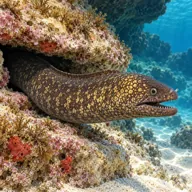
Mediterranean moray · Morina Can hurt you
Bites hard if a hand goes into its hole. Keep hands out of cracks and never feed one.
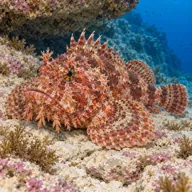
Red scorpionfish · Ċippullazza Can hurt you
Venomous spines, and it sits still on the rock. Look before you kneel or hold on; hot water if stung.
A bit of history
The name comes from the Maltese word for beard, after the appearance of the entrance. The cave is another erosion passage exploiting the joints and bedding in the Lower Coralline Limestone that makes up this whole stretch of coast, the same rock that produced the Inland Sea, the Blue Hole and the arch that used to stand at Dwejra.
Divers say
Sign in to rate this site and leave a note for the next diver.
- No reviews yet. First one gets bragging rights.
Further reading: Atlantis Gozo, Barba Cave · Greatest Dive Sites, 200 metre tunnel, Dwejra Point · Visit Gozo, Dwejra