Marsaskala · Malta
Marsaskala
A seaside town on Malta's south east coast whose dive sites all cluster around Żonqor Point: three wrecks on sand, reef on both flanks, and a collapsed sea cave a short drive up the coast.
Sea conditions
Good right now
Some chop (0.5 m E)
Forecast for the site, updated 01:46 AM
- Waves
- 0.5 m
- from E
- Wind
- n/a
- Swell
- 0.5 m
- 5 s period
- Sea temp
- 29 °C
Next 7 days
Exposed to wind and swell from: NE (45°), E (90°), SE (135°), S (180°). The go-to area when the north west is blowing. Flat and friendly in a north westerly, choppy and murky in anything from the east or south east. Best season: Year round, best from May to November, and most valuable in winter as the reliable alternative to the north and west coasts..
Dives at Marsaskala
Tugboat 10
Marsaskala, Malta
St. Michael
Marsaskala, Malta
P33
Marsaskala, Malta
Mini Blue Hole
Marsaskala, Malta
Żonqor Point
Marsaskala, Malta
The dive
Marsaskala is not where anyone plans their first Maltese dive holiday, and it is where a surprising number of those holidays are saved. When the north westerly is hammering Ċirkewwa and the Gozo channel boats are tied up, this corner of the south east coast sits flat and calm and lets everyone get wet.
Everything here works off the Żonqor Point peninsula on the north arm of the bay. On the sand south of the point lie three scuttled vessels: the tugs St. Michael and Number 10, both sunk on 16 May 1998, and the patrol boat P33 added between them in 2021 and since broken up by storms. Around and above them is reef, shallow and gently sloping, which serves as the return leg for the wreck dives and as a dive in its own right on both sides of the headland. Seven hundred metres up the coast towards Xgħajra sits the Mini Blue Hole, a collapsed cave with a short swim-through that is a favourite with photographers and training groups alike.
The trade-off is visibility. Marsaskala Bay collects more suspended material than the open north west coast, so this is not the place for that crystalline blue postcard shot. In exchange you get depth that never exceeds about twenty two metres, entries you can walk to from the car, and a whole area that works for beginners, refreshers and second dives.
There is also more to do at the surface here than at most Maltese dive sites. Parking, toilets, kiosks, cafes, restaurants, a dive centre and the big outdoor pool complex are all within a short stroll of where you kit up, which matters more than divers like to admit.
- Three wrecks and a reef reachable from one car park
- The island's most dependable shelter from the north westerly
- A collapsed cave with a swim-through just up the coast
- Depths that keep everything inside recreational limits
- Toilets, cafes and a dive centre a minute from your kit
Typical plan
The standard outing is a wreck circuit: out on a bearing from the Żonqor rocks, down the reef to the sand at eighteen to twenty metres, along to Tugboat 10, across the P33 debris, on to St. Michael at twenty two, then turn and drift home over the reef in five to ten metres. Fifty minutes on nitrox 32 in a 12 litre, or a shorter two-wreck version on air. For a second dive or a training session, stay on the reef either side of the point at ten to fifteen metres, or drive up to the Mini Blue Hole for a shallow cave and gully dive.
What the bottom looks like
- 1Shallow boulders and gullies off Żonqor8 m deep · 50 m out
- 2Reef base where the sand begins19 m deep · 140 m out
- 3Tugboat 1019 m deep · 165 m out
- 4P33 wreckage field20 m deep · 200 m out
- 5St. Michael22 m deep · 245 m out
- 6Open sand beyond the wrecks22 m deep · 320 m out
Low rocky reef close to shore stepping down to a flat, fine sand plain that carries the three wrecks.
Who you might meet
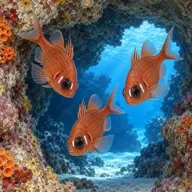
Cardinalfish
Almost always · Sultan iċ-ċawl
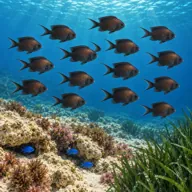
Damselfish
Almost always · Pixxi kahal · Summer
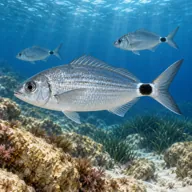
Saddled seabream
Almost always · Kaħlija
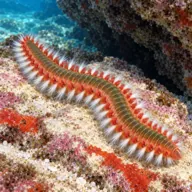
Fireworms
Almost always · Busuf · Summer
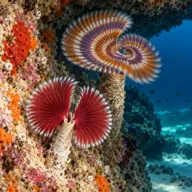
Encrusting sponges and tube worms
Almost always
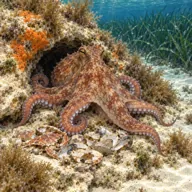
Octopus
Often · Qarnit · Autumn and winter
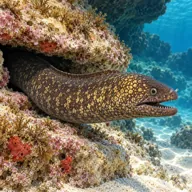
Mediterranean moray
Often · Morina
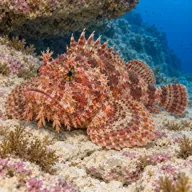
Scorpionfish
Often · Skorfna
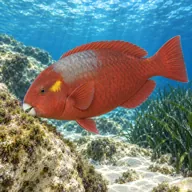
Mediterranean parrotfish
Often · Marnott · Summer
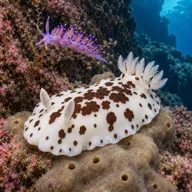
Nudibranchs
Often · Spring
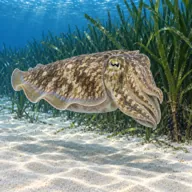
Cuttlefish
Sometimes · Siċċa · Spring
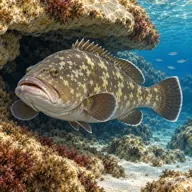
Dusky grouper
Lucky day · Ċerna
Getting in and staying safe
Drive to Żonqor Point in Marsaskala and park on the open ground beside the water. Everything launches from here: the wrecks and the southern reef from the rocks on the south side, Żonqor Point North from separate entries a few hundred metres along. The Mini Blue Hole is a separate trip, reached by the coastal track towards Xgħajra with informal parking and a rough walk down to the water. Facilities at the point include public toilets, kiosks, cafes and restaurants (several seasonal), a dive centre and a large outdoor swimming pool complex.
- Visibility consistently lower than elsewhere in the Maltese islands
- Slippery rock entries and heavy sea urchin cover
- Boat traffic entering and leaving Marsaskala Bay
- Silty sand around the wrecks
- Broken, sharp wreckage at the P33 site
- Discarded fishing line near the point
- Busy in summer with swimmers and small craft
A bit of history
Diving in Marsaskala was transformed on 16 May 1998, when the Cassar Group's donated tugs St. Michael and Number 10 were scuttled off Żonqor Point. The site was picked for practical reasons: shelter from the prevailing north westerly, flat sand with no protected seagrass to damage, and a depth of around twenty metres within reach of ordinary recreational divers. Both tugs were cleaned out first, with glass, doors and hatches removed and passageways opened up. The project turned a barren patch of seabed into a shore-accessible wreck site, and it worked so well that the patrol boat P33 was added on 31 July 2021. The tugs themselves carry older histories, St. Michael built in Canada in 1944 for wartime service and Number 10 built locally for Grand Harbour work.
Divers say
Sign in to rate this site and leave a note for the next diver.
- No reviews yet. First one gets bragging rights.
Further reading: Malta Dive Sites: Marsaskala · DIVE Magazine on the Żonqor wreck site · Malta Tourism Authority Dive Site Report 5: Zonqor Point North