Malta
Mosquito Fighter Bomber
A wooden warplane that has mostly gone back to the sea, leaving two engines and a cat's cradle of cable sitting upside down on sand at just over 40 metres off Delimara. Short, deep and atmospheric.
Sea conditions
Good right now
Some chop (0.5 m E)
Forecast for the site, updated 01:46 AM
- Waves
- 0.5 m
- from E
- Wind
- n/a
- Swell
- 0.5 m
- 5 s period
- Sea temp
- 29 °C
Next 7 days
Exposed to wind and swell from: NE (45°), E (90°), SE (135°), S (180°). Needs a settled day with light westerlies, which push the swell off the land here. Anything from the east quadrant makes the boat ride miserable and the shot line hard to hold. Visibility is usually generous at this depth, often 25 metres or more, but the sand stirs easily if a group gets clumsy. Best season: May to October, with September and early October giving the warmest water and the calmest eastern sea..
The dive
The Mosquito was famously built out of plywood and glue, which made it fast and quiet in the air and hopeless at surviving seventy-odd years underwater. What the sea left behind is the skeleton crew of the aircraft: two big radial-shaped engine blocks, one still wearing its propeller, joined by a spine of buckled metal framing and a tangle of control cables. The tail, being aluminium, is still down there but half swallowed by the sand.
It sits inverted on a floor of pale sand broken up by low reef patches, which is a gift for photographers because the wreckage reads as dark sculpture against a bright background. There is no swim-through, no penetration, nothing to hunt for inside. The dive is about the shape of the thing and the small story attached to it.
At 40 to 42 metres this is a bottom time of fifteen minutes at best on a single mix, and the current has a habit of turning up uninvited. Most centres run it as the deep leg of a two-tank day with the Bristol Blenheim, which lies not far away, so you get two aircraft and a boat ride for the price of one morning.
Go in with a plan, hold your deco stops honestly, and treat the debris field gently. Everything you touch is thin, corroded and eighty years past its warranty.
- Two intact engines, one still carrying its propeller
- A wooden aircraft reduced to its metal bones, which is oddly moving
- Pale sand backdrop that makes the wreckage photograph beautifully
- Easily paired with the nearby Bristol Blenheim for a two-aircraft day
- Quiet site with almost no other boats on it
Typical plan
A single deep bounce. Down the shot to the engines at 41 to 42 metres, a slow lap of the debris field keeping the two engines as your anchors, then out to the tail and back. Fifteen to eighteen minutes of bottom time on 28 to 30 percent nitrox, or a proper staged plan with a deco mix if you want longer. Ascend the line, hang your stops, and send a DSMB well before you hit the surface.
What the bottom looks like
- 1Port engine block, upside down on the sand41 m deep · 16 m out
- 2Starboard engine with propeller still attached42 m deep · 22 m out
- 3Twisted frame and cable run between the engines42 m deep · 30 m out
- 4Aluminium tail section half buried42 m deep · 55 m out
- 5Low rocky outcrops around the debris field39 m deep · 110 m out
- 6Scattered airframe fragments40 m deep · 140 m out
Fine pale sand with occasional low rock and reef patches poking through.
Who you might meet

Encrusting sponges
Almost always · Sponża

Common octopus
Often · Qarnit

Cardinalfish
Often · Re tat-trilji
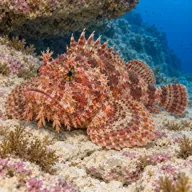
Red scorpionfish
Often · Ċippullazza

Dusky grouper
Sometimes · Ċerna

Conger eel
Sometimes · Gringu

Common stingray
Sometimes · Bokkatura
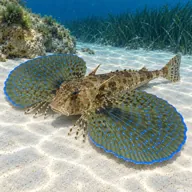
Flying gurnard
Sometimes · Bies

Amberjack
Sometimes · Aċċola · Late summer

Barracuda
Sometimes · Lizz
Getting in and staying safe
Boat only, and normally launched out of Marsaxlokk or Birzebbuga for the short run round to the east side of Delimara. There is no shore option and no realistic swim, so you are booking onto a charter rather than driving yourself somewhere. Expect a shot line, a live boat pick-up and a surface interval spent bobbing off a fairly bleak stretch of coast, so bring water and something to sit on. Nearest coffee and toilets are back in Marsaxlokk.
- Depth of 40 to 42 metres puts this squarely in decompression territory on air
- Currents run here at times and can be strong enough to make the descent line a handful
- Sharp corroded metal and loose cable around the engines, easy to snag a hose or a fin
- Low ambient light at depth, with narcosis creeping in on a cold or tired diver
- Open water boat traffic to and from Marsaxlokk, deploy a DSMB before surfacing
- No shelter or exit if the weather turns while you are down
A bit of history
The de Havilland DH.98 Mosquito was a twin-engined British aircraft of about 13.6 metres length and a 16.5 metre wingspan, used as a fighter, bomber, night-fighter and photo-reconnaissance machine. This particular aircraft went down on 26 March 1949, several years after the war it was designed for. On a mail run out of Malta the starboard engine started misbehaving on take-off, the crew turned back for Hal Far, and the aircraft ended up in the water rather than on the runway. It is one of a cluster of aviation wrecks scattered around the island, the Bristol Blenheim, the Beaufighter and the Lockheed Neptune among them, with a deeper set of Junkers, a Liberator, a Swordfish and a Skyraider reserved for technical divers.
Divers say
Sign in to rate this site and leave a note for the next diver.
- No reviews yet. First one gets bragging rights.
Further reading: Malta Dive Sites: Mosquito Fighter Bomber · Techwise Malta: Mosquito Fighter Bomber Wreck · Divers Guide: Mosquito · PADI dive site: Mosquito Fighter Bomber · Wrecksite.eu entry