Malta
Bristol Blenheim Bomber
A Blenheim light bomber sitting upright on sand and low reef at 42 m off the southeast coast, ditched in 1941 with the whole crew walking away. Deep, current prone and worth the effort.
Sea conditions
Good right now
Some chop (0.5 m E)
Forecast for the site, updated 01:46 AM
- Waves
- 0.5 m
- from E
- Wind
- n/a
- Swell
- 0.5 m
- 5 s period
- Sea temp
- 29 °C
Next 7 days
Exposed to wind and swell from: NE (45°), E (90°), SE (135°), S (180°). Open to anything coming out of the eastern half of the compass, and the local current runs hardest when the wind has been up. A settled northwesterly or a calm day is the window. Ask the skipper about current on the day, not the forecast alone. Best season: June to October for the most reliable flat days and warm water. Currents ease in settled midsummer conditions..
The dive
This is the deep one of Malta's recreational aircraft wrecks and it feels like it. You leave the boat, drop through a lot of blue, and the seabed arrives at 42 m as a mix of sand and scrappy low reef. Then the wings appear, laid out flat and wide, with the two radial engines still sitting where they should be. Starboard still carries a bent propeller. Port lost its blades long ago.
What is left is more skeleton than aeroplane. The cockpit canopy has gone, the turret and its guns were lifted decades ago, and the rear fuselage has snapped away and lies a short swim off, upside down and mostly under sand. Even the pilot's seat was removed by souvenir hunters at some point. Photographs from the first RAF Sub Aqua Club surveys in the late sixties show something far more complete than what you meet today, and the corrosion between dissimilar metals keeps quietly working away at the rest.
Plan it tightly. At 42 m the no stop clock is close to meaningless, so most centres run this on nitrox with a conservative profile or as a light decompression dive for suitably qualified divers. Current is the other variable and it can be genuinely strong here, which turns a leisurely wander around the wings into a hard swim. Get the layout in your head from the briefing, work the wreck in one direction, and do not chase the tail section unless you have the time and gas to get back.
- Wings and both radial engines still laid out in aircraft shape
- Bent starboard propeller, the signature photograph of the site
- Detached tail section lying inverted nearby
- One of the deepest aircraft still inside recreational range in Malta
- A ditching story where every one of the three crew survived
Typical plan
Shot line down to 42 m, straight onto the main wreckage. Work the starboard engine and propeller first, cross the centre section to the port engine, then only visit the detached tail if gas and time allow. Nitrox 28 is close to ideal for the depth. Realistic bottom time is ten to fifteen minutes with a slow ascent, a deep stop and a long 5 m stop, deploying a surface marker early because the current will carry you off the site.
What the bottom looks like
- 1Main wreckage, wings and centre section upright42 m deep · 30 m out
- 2Starboard radial engine with bent propeller42 m deep · 36 m out
- 3Port engine, propeller missing42 m deep · 42 m out
- 4Detached rear fuselage, inverted and part buried42 m deep · 58 m out
- 5Low scattered reef patches on the sand42 m deep · 70 m out
- 6Open sand beyond the wreck field41 m deep · 80 m out
Sand broken up by low rocky outcrops, so the wreckage sits in a patchwork rather than on a clean plain.
Who you might meet
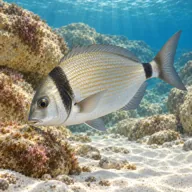
Common two banded seabream
Almost always · Sargu

Damselfish
Almost always · Kaħlija
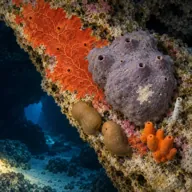
Encrusting sponges
Almost always · Sponża
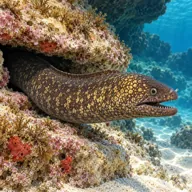
Mediterranean moray
Often · Morina
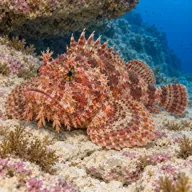
Scorpionfish
Often · Ċippullazza
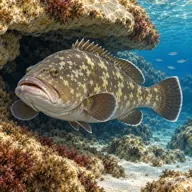
Dusky grouper
Sometimes · Ċerna

Barracuda
Sometimes · Lqiq · late summer

Amberjack
Sometimes · Aċċola · autumn

Common octopus
Sometimes · Qarnit

Cardinalfish
Sometimes · Sultan iċ-ċawl
Getting in and staying safe
Boat only, usually from Marsaxlokk, Marsaskala or the southeast dive centres. It is an exposed corner of coast so trips get cancelled readily. Expect a shot line and a drift back to the boat rather than a return to the anchor. Advanced or deep certification is the normal minimum and centres will ask about your recent deep experience.
- 42 m puts you well into narcosis territory and eats gas fast
- Currents here can be strong and are the main reason trips get scrubbed
- Decompression obligation is easy to pick up by accident
- Fragile, thin corroded alloy that breaks if you hold it
- Silt over the buried sections, easily stirred
- Tail section is a separate swim, so navigation errors cost gas
- Open water surfacing with no shore option
A bit of history
The Bristol Blenheim was a twin engine light bomber with a crew of three, roughly 13 m long with a 17.2 m wingspan. This aircraft, a Mark IV of No. 18 Squadron RAF, was heading out towards Greece on 13 December 1941 when an Italian fighter jumped it en route and wrecked the port engine. The pilot turned back for Malta, ran out of options short of the airfield, and put her down on the water beside a Maltese fishing boat in what witnesses described as a textbook ditching. All three of the crew survived with nothing worse than minor injuries. Divers located the wreck in 1965 and the RAF Sub Aqua Club surveyed it in 1968, when it was still remarkably complete.
Divers say
Sign in to rate this site and leave a note for the next diver.
- No reviews yet. First one gets bragging rights.
Further reading: Underwater Malta virtual museum: Blenheim Bomber · Malta Dive Sites: Bristol Blenheim Bomber · Dive Shack Malta site guide · Wrecksite.eu entry