Malta
Luciston Collier
A British coal carrier torpedoed in 1916 on her way to Malta, now lying beyond a hundred metres off the south east coast. A trimix expedition dive, permit only, with a deck gun still bolted down.
Sea conditions
Good right now
Some chop (0.5 m E)
Forecast for the site, updated 01:47 AM
- Waves
- 0.5 m
- from E
- Wind
- n/a
- Swell
- 0.5 m
- 5 s period
- Sea temp
- 28 °C
Next 7 days
Exposed to wind and swell from: N (0°), NE (45°), E (90°), SE (135°), S (180°), SW (225°). Sitting well out from Delimara, the site is open to most of the compass and is known for rough conditions. It needs a genuinely flat day with light offshore wind, because decompressing for over an hour under a pitching boat is not something anyone wants to repeat. Best season: June to September, on the settled windows. Even then expect more cancelled attempts than successful ones..
The dive
This is not a dive you fit around a holiday. The Luciston sits somewhere between ninety six and a hundred and four metres on an exposed piece of open sea, which puts her firmly in expedition territory: closed circuit rebreathers or a wall of stages, a long decompression schedule, and a weather window that has to be right on the day rather than approximately right.
What you get for that effort is a hundred metre steamer that has been quietly breaking down for over a century. The hull is fragmentary rather than whole, but the big recognisable pieces are all still there and readable. Survey work by the University of Malta has recorded the deck gun still bolted in position, an anchor, winches and ladders, which is a lot more character than most wrecks retain at this depth.
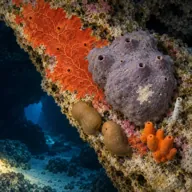
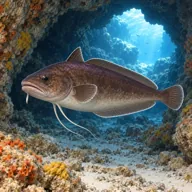
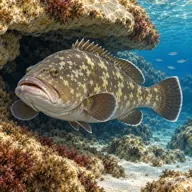
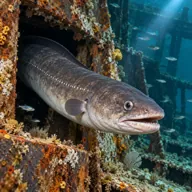
At a hundred metres in the central Mediterranean the light is low, the water is cold and the visibility is usually superb, which makes for a strangely serene twenty minutes. Marine life is sparse and deliberate: the odd big grouper, forkbeard in the shadows, and enough deep water growth on the plating to soften every edge. Then you turn around and start the long climb back.
- Deck gun still bolted to the plating after more than a century
- A First World War collier sunk by the same U-boat as Le Polynesien
- Anchor, winches and ladders recorded by University of Malta survey work
- One of Malta's deepest permitted historic wrecks
Typical plan
Expedition trimix or closed circuit only. Twenty to twenty five minutes on the bottom between ninety six and a hundred and four metres, covering one end of the wreck, then two to three hours of staged decompression on the line with multiple gas switches and oxygen at the shallow stops. Support diver, spare cylinders hung on the line, surface oxygen and an evacuation plan agreed before anyone gets wet. Book the permit and a registered operator well ahead.
What the bottom looks like
- 1Upper collapsed plating where the shot lands94 m deep · 30 m out
- 2Anchor and forward ground tackle96 m deep · 45 m out
- 3Winches and deck ladders98 m deep · 75 m out
- 4Open coal holds100 m deep · 105 m out
- 5Boiler and engine remains102 m deep · 140 m out
- 6Stern deck gun still bolted in place103 m deep · 170 m out
- 7Seabed beside the hull104 m deep · 195 m out
Flat sand and mud at around a hundred and four metres, with debris scattered out from the broken hull.
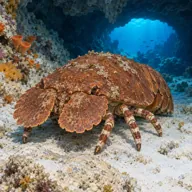
Who you might meet




Getting in and staying safe
Boat only, and organised through a dive centre registered with Heritage Malta. Runs go out from Marsaxlokk, St Thomas Bay or Marsaskala, roughly thirty to forty five minutes depending on sea state. A shot line goes in first and is recovered afterwards, and the boat stays over you for the full run time. Plan on the entire day for one dive, with a full deco station, oxygen, spare gas and someone competent minding the surface.
- Depth beyond a hundred metres, hypoxic trimix and hours of decompression
- Fully exposed offshore position with no shelter and a long run home
- Current at depth and on the decompression line
- Fragmented, unstable wreckage with sharp collapsed plating
- Low light and narrow useful bottom time, easy to lose track of the exit
- Fishing gear snagged across the wreck
- Protected site and war casualty: nothing may be moved or lifted
- Any problem at this depth becomes a serious problem very quickly
A bit of history
SS Luciston was built in 1910 by R. Duncan and Company of Port Glasgow, a British steam collier of roughly 2,948 tons, about ninety eight metres long. On 29 November 1916 she was carrying coal from Cardiff to Malta when the German submarine UC-22, the same boat that would sink Le Polynesien two years later, put a torpedo into her. The crew got off. She went down a few miles off Marsaxlokk and stayed lost until divers located the wreckage in the 1990s, though she was not properly surveyed and positively identified until 2015. Since 1 May 2019 she has been one of the historic wrecks opened to permitted diving under Heritage Malta's Underwater Cultural Heritage Unit, which manages the site as an archaeological zone.
Divers say
Sign in to rate this site and leave a note for the next diver.
- No reviews yet. First one gets bragging rights.
Further reading: Heritage Malta, SS Luciston · DIVE Magazine, Malta's deep wrecks: SS Luciston · Wrecksite, SS Luciston · Divernet, eight new deep Malta wrecks opened to diving