Malta
Rdum il-Qawwi
A jumble of huge fallen boulders under the Marfa ridge cliffs, stitched together by arches, swim-throughs and small caves in the shallows, with a slope that runs on to 45 m if you want it.
Sea conditions
Excellent right now
Flat, sheltered and calm
Forecast for the site, updated 01:45 AM
- Waves
- 0.3 m
- from SE
- Wind
- n/a
- Swell
- 0.2 m
- 5 s period
- Sea temp
- 29 °C
Next 7 days
Exposed to wind and swell from: W (270°), NW (315°), N (0°), SW (225°). Sheltered from the north-east wind, wide open to everything from west through north. Swell surging through the boulder gaps is the thing that shuts it down rather than the wind itself, so check the swell forecast and not just the breeze. Best season: Late spring through early autumn, when the western swell settles down.
The dive
Rdum il-Qawwi translates roughly as the strong cliff, and the name tells you what has happened here. Large slabs of Upper Coralline limestone have peeled off the face over the centuries and piled up in the shallows, and the gaps between them are the dive. Most of the good stuff sits between 5 and 15 m, where the boulders lean on each other to form arches and short swim-throughs and the odd cave big enough to turn around in.
Beyond the boulder field the ground softens into seagrass and rubble and slopes away steadily towards the mid forties. That deeper section is honestly the least interesting part. Divers who have logged it tend to say the same thing: the shallow architecture is fun, the marine life is thin compared with nearby Qammieħ, and you should treat it as a gentle explore rather than a headline dive.
What it does have is sponges and golden zoanthids on the shaded undersides of the blocks, wrasse working the seagrass, and a complete absence of anyone else. On a flat day with good light, weaving through the arches at 8 m with the cliff towering above the surface is a genuinely lovely way to spend an hour.
- Arches and swim-throughs formed by collapsed cliff blocks
- Shallow enough to make a long, easy, torch-in-hand explore
- Golden zoanthids and sponge growth under the overhangs
- Total solitude under one of Malta's biggest cliffs
Typical plan
This works best as a long shallow dive. Start at the deepest point you fancy, twenty to twenty five metres on the slope, then work steadily back up into the boulder field and spend the bulk of your gas between 12 and 6 m weaving the arches and swim-throughs. Sixty to seventy minutes on a single 12 litre is realistic. Take a torch for the undersides of the blocks, and a DSMB if you are coming up away from the shore. Nothing here needs decompression planning unless you deliberately run the slope deep.
What the bottom looks like
- 1Fallen slabs in the shallows4 m deep · 10 m out
- 2Arch formed by leaning blocks7 m deep · 28 m out
- 3Small cave along the shoreline10 m deep · 45 m out
- 4Short swim-through between boulders13 m deep · 60 m out
- 5Posidonia meadow on the slope21 m deep · 100 m out
- 6Rubble and sand at the deep end40 m deep · 200 m out
Huge tumbled limestone boulders in the shallows giving way to Posidonia meadow, rubble and sand as the ground slopes into the forties.
Who you might meet
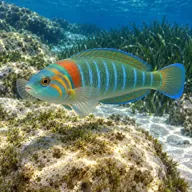
Ornate wrasse
Almost always · Ħaruġ
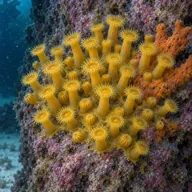
Golden zoanthids
Almost always
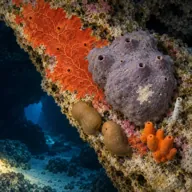
Encrusting sponges
Almost always · Sponoż
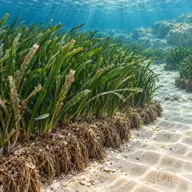
Posidonia meadow
Almost always · Alka
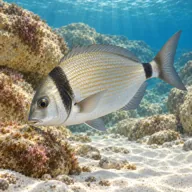
Two-banded bream
Often · Sargu
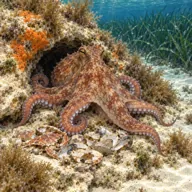
Octopus
Sometimes · Qarnit
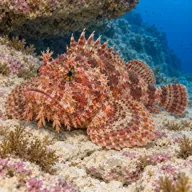
Scorpionfish
Sometimes · Ċippullazza

Cardinalfish
Sometimes · Re tat-trilji
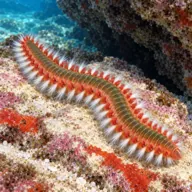
Fireworm
Sometimes · Dudu tan-nar · Summer
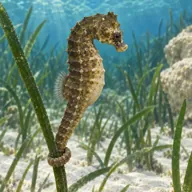
Seahorse
Lucky day · Żiemel tal-baħar
Getting in and staying safe
Shore access exists but it is hard work: over 500 steps and a long scramble down from the ridge road above, then a rock entry with no ladder. Almost everyone dives it from a boat out of Cirkewwa instead, which takes fifteen minutes and saves your knees. If you do walk it, carry minimal kit, go with someone who has done it before, and think carefully about the climb back out in full gear with a tired body.
- Very long stepped walk in and out if you go from shore, in full kit
- Slippery and unstable boulders at the waterline
- Surge pushing you into gaps between blocks when there is any swell
- Overhead environment in the larger swim-throughs
- Exposed west and north-west aspect with no shelter
- Falling rock from an actively eroding cliff
A bit of history
The cliff is part of the Marfa ridge, a block of hard Upper Coralline limestone sitting on Blue Clay. Water gets into the clay, the clay slumps, and the limestone above breaks away in enormous slabs. The rdum, the Maltese word for this kind of boulder scree coast, is the result, and the same process built the underwater boulder fields at Ahrax, Qammieh and Ghajn Tuffieha.
Divers say
Sign in to rate this site and leave a note for the next diver.
- No reviews yet. First one gets bragging rights.
Further reading: Calypso Sub-Aqua Club: Rdum il-Qawwi · Malta Dive Sites entry and diver report · Location and elevation of the Rdum il-Qawwi cliff