⭐ Echinoderms · Holothuria spp.
Sea cucumbers
Bużżu tal-baħarin Maltese, also Qallut il-baħar
Living vacuum cleaners of the sand
Meet the Sea cucumbers
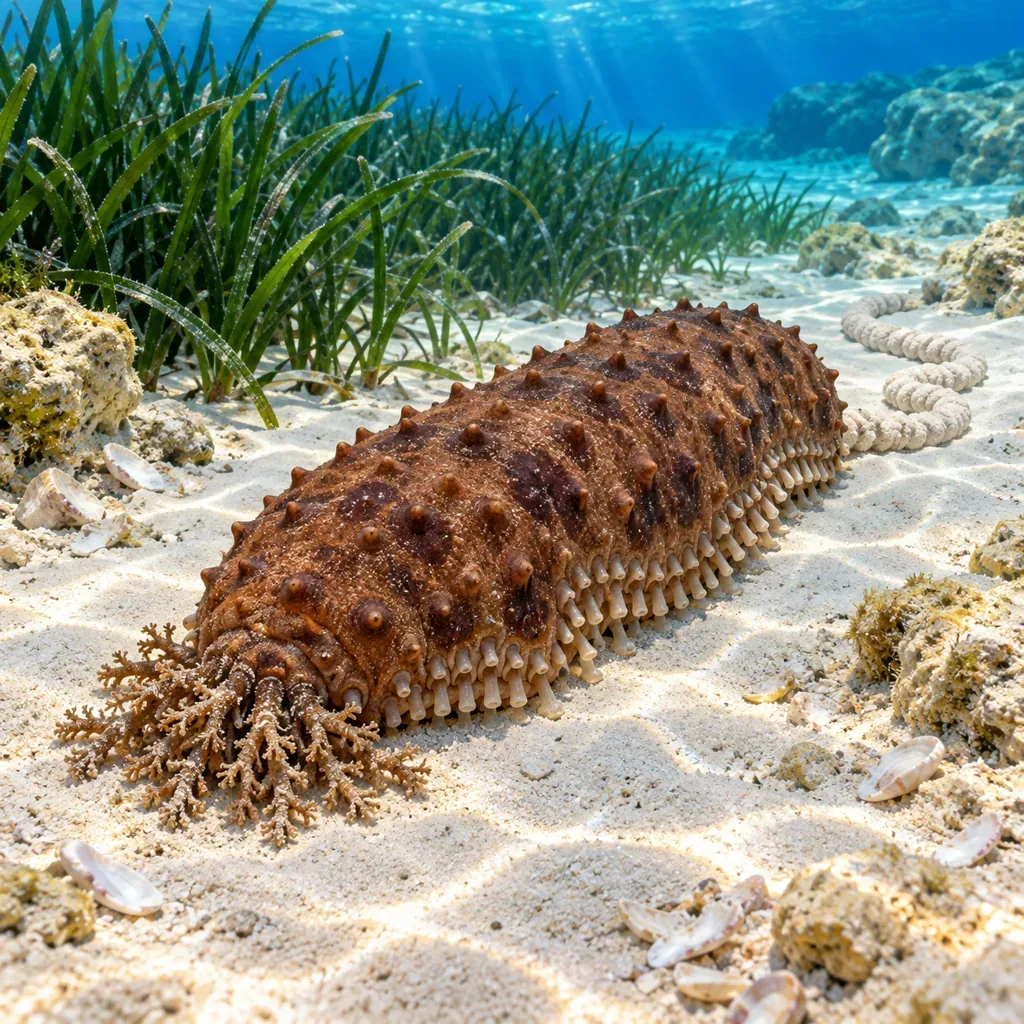
Seven species of Holothuria have been recorded from the Maltese islands and telling them apart properly needs a microscope, but three are easy enough underwater. Holothuria tubulosa is the big brown one lying out in the open in seagrass and on sand: a leathery sausage twenty to forty centimetres long, tan to dark chocolate, its upper surface studded with soft conical bumps that give it a warty outline. Holothuria poli is smaller, paler and greyer, usually tucked half under a rock with rows of white-tipped tube feet showing along its flanks. Holothuria forskali is the glossy black one on rocky reef, smoother-looking with yellow-tipped papillae, and the one to be a little careful with.
They live from just below the surface down past forty metres, and you will find them on almost every Maltese shore dive: strewn across the sand between Posidonia clumps, wedged into boulder gaps, and lying on the silty flats inside sheltered bays. At the front end a ring of short, branching, mop-like tentacles works constantly, shovelling sand and sediment into the mouth.
Everything they eat is sediment. They strip the organic film, bacteria and detritus off sand grains and pass the clean sand out the other end as neat casts, which is why the trails behind them look like someone piped toothpaste along the seabed. A large Maltese meadow can have a startling density of them, and between them they turn over a serious volume of sand every year.
When to look: All year; in the warm months you may find one reared up on its back end, waving its front into the current, which is spawning behaviour.
Diving with them
- Look for the sand casts first. A fresh trail of cleaned sand almost always ends at a sea cucumber a few centimetres away.
- They are one of the easiest macro subjects in Malta: get the ring of feeding tentacles at the front end in focus and the picture tells a story.
- Do not pick them up, and be especially careful with the glossy black Holothuria forskali, which fires sticky white threads when handled.
- They are good practice for buoyancy. Hovering over one without stirring up the silt around it is a genuine skill test.
- On night dives their feeding tentacles are usually out and working, which is when the front end is worth a proper look.
Can it hurt you?Handle with care
Harmless unless you handle them. The black Holothuria forskali defends itself by ejecting a mass of sticky white Cuvierian threads that glue themselves to skin and gear and are very unpleasant to get off, and the fluid they come with can irritate skin and badly sting the eyes.
First aid: Peel the threads off rather than rubbing them in, and rinse the area with seawater then fresh water. Wash your hands thoroughly before touching your face, mask or contact lenses. If any of the fluid reaches the eyes, flush with plenty of clean water for at least fifteen minutes and get medical advice if irritation persists.
Easily confused with
- The three common Maltese species themselves: brown and warty out in the open is Holothuria tubulosa, pale grey and half-hidden is H. poli, glossy black on rock is H. forskali.
- Sea hares (Aplysia spp.) — similar size and sluggishness but they are molluscs, with two obvious ear-like tentacles on the head and frilly flaps along the back.
- Large dark sponges or bits of debris on sand, which is what most divers mistake a resting sea cucumber for on the way past.
Where to meet them: 4 sites
Għar Ħasan
Malta
Sirens
Malta
Slugs Bay
Malta
Further reading: Wikipedia: Holothuria tubulosa · Wikipedia: Holothuria forskali and its Cuvierian tubules · Dive Shack Malta marine life guide: black sea cucumber · MaltaWildPlants forum: Maltese names and Holothuria species recorded from the Maltese islands · Aquaculture: culturing Holothuria poli at a Maltese coastal fish farm