🐟 Fish · Symphodus tinca
Peacock wrasse
Lappunin Maltese, also Lħudi Tork, Tirda, Tirda pagun
The big seagrass wrasse that builds a nest
Meet the Peacock wrasse
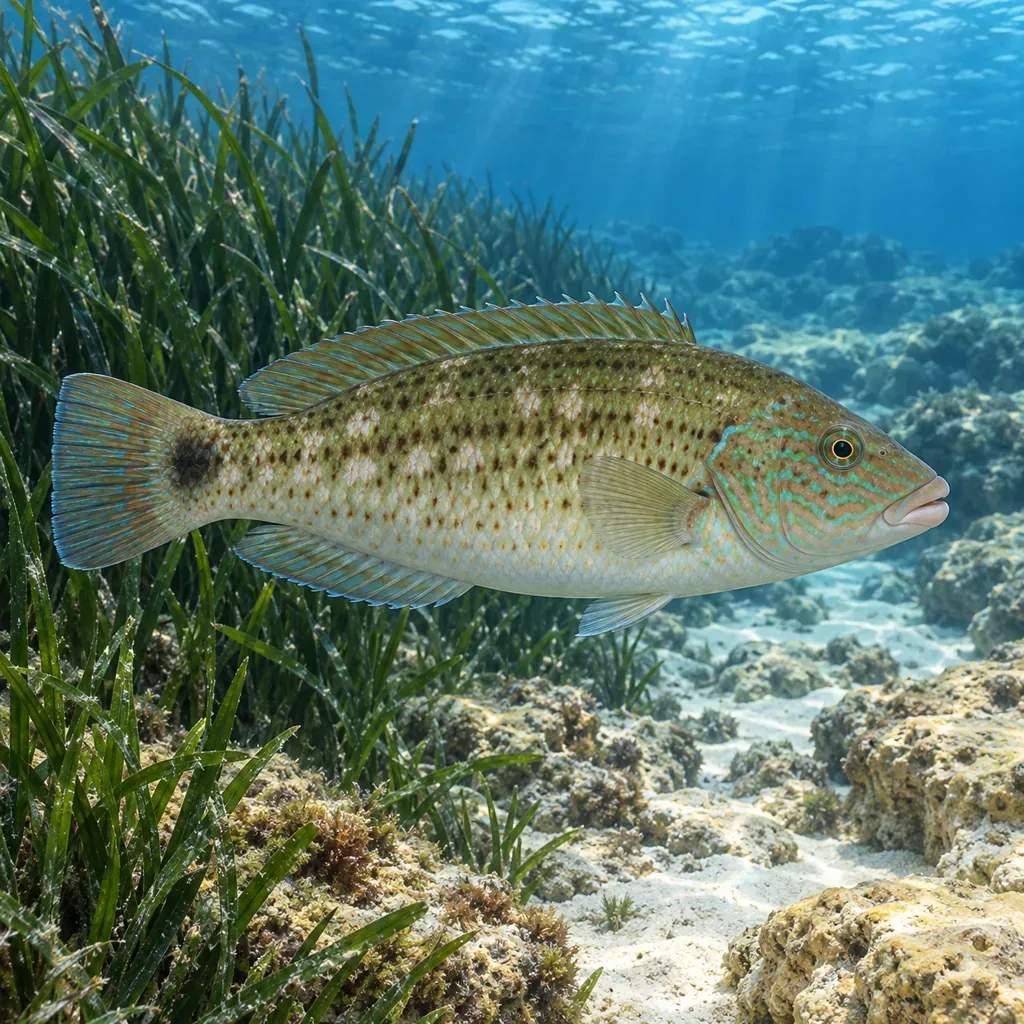
The largest of the Symphodus wrasses in the Mediterranean and a fish most Maltese divers see on every seagrass dive without ever putting a name to it. It has a fairly deep, laterally flattened body, a noticeably pointed snout and thick lips. The usual colour is olive to greenish-brown with rows of small dark spots and blotches along the flanks, a pale belly and a dark smudge on the tail base. Breeding males go far brighter, with blue and green lines scribbled across the head and cheeks and a stronger black blotch behind the gill cover.
Most fish you meet are 20 to 25 cm; the record is over 40 cm, which for a wrasse is substantial. It picks its way slowly along the bottom crunching small urchins, brittlestars, bivalves, shrimp and crabs with its heavy jaws, so it is often found nosing among the roots at the edge of a meadow.
Around Malta, Gozo and Comino it is common between about two and thirty metres wherever Posidonia meets rock, and it is one of the species that makes the shallow bays at Ġnejna, Xlendi and Mġarr ix-Xini worth a slow look. In spring the male gathers loose algae into a nest on the bottom and guards it for weeks while several females spawn in it.
When to look: All year; April to June is the time to see males in full colour tending nests.
Diving with them
- Search the boundary where Posidonia meets rock rather than the open meadow or the bare reef
- In spring look for a tidy heap of loose algae on the bottom with a bright male fussing over it - hover, do not fin over it
- It swims steadily rather than darting, so it is one of the easier wrasses to frame
- Tell it from the smaller Symphodus wrasses by size and the pointed snout
- Do not hand-feed it; fish here learn that quickly and it changes behaviour on the whole site
Can it hurt you?Harmless
Harmless to divers. The jaws are strong enough to crush a small urchin but the fish has no interest in anything that size and keeps its distance.
Easily confused with
- Five-spotted wrasse (Symphodus roissali) and ocellated wrasse (Symphodus ocellatus) - both much smaller with blunter snouts
- Axillary wrasse (Symphodus mediterraneus) - smaller, with a dark spot at the pectoral base and a red-edged tail
- Brown wrasse (Labrus merula) - heavier and uniformly dark, without the rows of spots
Where to meet them: 10 sites
Armier Bay
Malta
Sirens
Malta
Tac-Cawla Rocks
Gozo
Xgħajra Reef
Malta
Further reading: FishBase - Symphodus tinca · Il-Miklem - Lħudi Tork / Symphodus tinca · Il-Miklem - Maltese fish names (Lappun) · Vassallo History - Maltese, English and Latin fish names