🪸 Corals & anemones · Madrepora oculata and Desmophyllum pertusum
Cold-water corals
Malta's deepest reefs, far below any diver
Meet the Cold-water corals
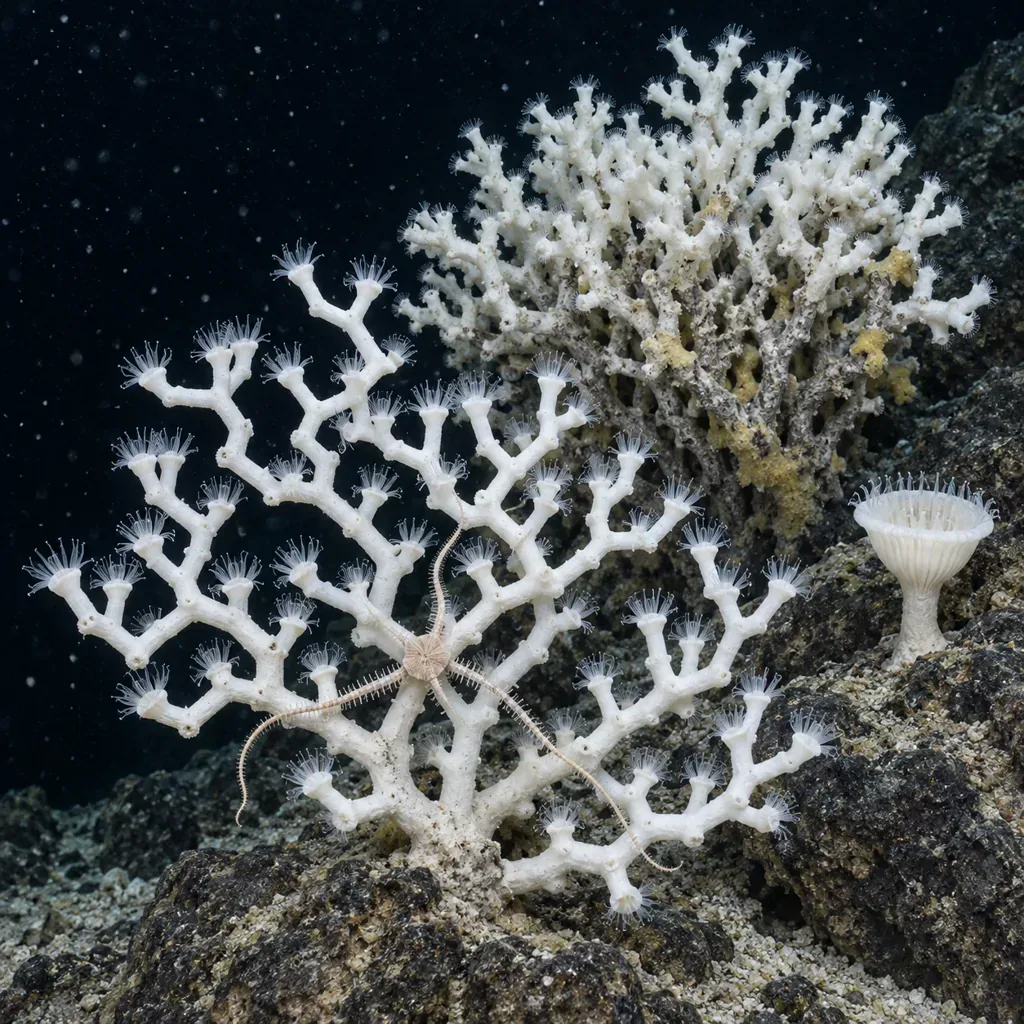
These are stony reef-building corals that live without sunlight, in cold dark water, feeding entirely on what the current brings. Two species build the frameworks: Madrepora oculata, which grows in a distinctive flattened zig-zag with white to pale orange branches, and Desmophyllum pertusum, better known to most divers by its old name Lophelia pertusa, which piles up into bushy white thickets. The big solitary cup coral Desmophyllum dianthus, a chalky white goblet on a stalk, grows among them, and over centuries the dead skeletons build a hard reef that sponges, brittle stars, crabs and deep-water fish move into.
Off the Maltese islands they are real but utterly out of reach. Living colonies and framework have been recovered from around 400 to 620 m, and the LIFE BaĦAR for N2K project's remote-vehicle surveys found stony reef corals most abundant deeper than 500 m. That is far beyond any diving, technical included, and the honest picture for a Maltese diver is that this is a habitat you will only ever see through survey footage.
They matter anyway. These are among the slowest-growing, oldest and most fragile habitats in Maltese waters, and the survey work that mapped them is exactly why Malta's offshore marine Natura 2000 sites were extended into deep water.
When to look: No seasonal window; the deep sea off Malta sits near 13 to 14 C all year and these corals are beyond all diving depths.
Diving with them
- Not a dive: these assemblages sit hundreds of metres below any technical diving limit around Malta
- The realistic encounter is a dead fragment - white zig-zag branches or a chalky goblet - washed up or caught in fishing gear
- Know the shape anyway, because divers are sometimes shown deep survey footage and asked to help identify it
- If you fish or dive from a boat over the offshore banks, lost longline and net are the main thing that destroys these reefs
- Report any suspected deep coral fragment with position and depth to a Maltese marine research group rather than keeping it
Can it hurt you?Harmless
No risk to divers, since they live far deeper than anyone can dive.
Easily confused with
- Red coral (Corallium rubrum) - also deep but solid red with white polyps, and found in caves at diveable depth as well
- Dead shallow coral rubble and coralline algae washed up on beaches - chalky but lumpy, without the neat zig-zag branching of Madrepora
- Bryozoan and worm-tube crusts - white and hard but flat and lacy rather than branching
Where to meet them: 1 sites
Further reading: Springer - Recent discoveries of extensive cold-water coral assemblages in Maltese waters · Living deep-water Lophelia and Madrepora corals in Maltese waters · EU LIFE - LIFE BaHAR for N2K project summary · Wikipedia - Madrepora oculata