🪼 Jellyfish · Cotylorhiza tuberculata
Fried egg jellyfish
Bramain Maltese
Breakfast, drifting past at five metres
Meet the Fried egg jellyfish
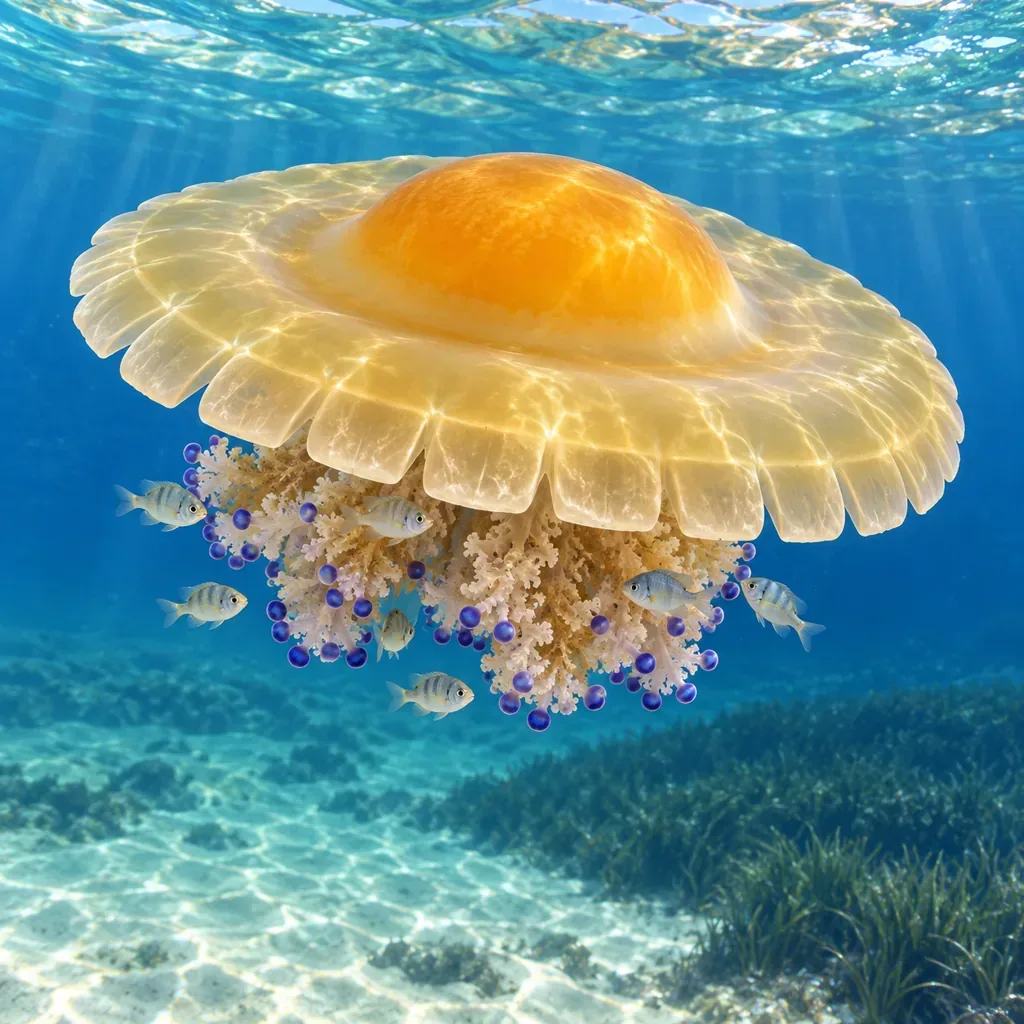
A large, flat, pale yellow-brown disc with a raised egg-yolk dome bulging from the middle - the resemblance to a fried egg is immediate and nobody has ever improved on the name. The rim is cut into neat rectangular lappets, and underneath hang short, much-branched mouth arms ending in small club-shaped knobs tipped violet, blue or white. Most are 20 to 35 cm across; big ones reach about 40 to 50 cm. It swims with a slow, steady pulse and does not drift helplessly the way many jellyfish do.
The brown tint in the tissue is not pigment but symbiotic algae living inside it, so the animal is part jellyfish and part solar panel and prefers warm, sunlit surface water. It is also a floating hotel: small fish, typically juvenile horse mackerel and bogue, live in and around the arms and dart under the bell when anything threatens, and shrimps and small crabs ride along too.
Around Malta and Gozo it is a late-summer and autumn animal, blooming roughly from August to November, with September usually the peak, and it is easiest to see in the first few metres in sheltered bays and along the north coast. It is the one large jellyfish Maltese swimmers actually enjoy meeting. Maltese has no distinct name for it - brama covers every jellyfish - so it is usually just called the fried egg.
When to look: Late summer and autumn, roughly August to November with a September peak, in warm surface water.
Diving with them
- Look up - they hang in the top few metres, so the best views come during the descent and the safety stop
- Approach from the side and level with it; coming up from underneath makes the resident fish bolt
- Watch the escort of small silver fish sheltering among the arms; it is the most photogenic thing about the animal
- Backlight it against the surface with the sun behind and the yolk dome glows amber
- Do not lift one out of the water or handle it; the arms break easily and the fish it shelters lose their cover
- Snorkellers see them better than divers, since they rarely go deep
Can it hurt you?Handle with care
Practically harmless. Its stinging cells are too weak to get through normal skin and most people feel nothing at all; sensitive skin or thin areas like the inner wrist or lips may pick up a faint tingle or slight itch.
First aid: Rinse the area with seawater rather than fresh water and leave it alone; a cold pack settles any itch, and no other treatment is needed.
Easily confused with
- Barrel jellyfish, a similar size but bluish-white with a smooth solid dome, a violet fringe around the rim and eight thick cauliflower arms
- Mauve stinger, far smaller, purple-pink and warty, with long thin trailing tentacles - and that one really does sting
- Nomad jellyfish, an invasive Red Sea species occasionally recorded in the region, whiter and with a much stronger sting
Where to meet them: 1 sites
Further reading: Atlantis Gozo Diving: fried egg jellyfish in Maltese waters · THINK Magazine (University of Malta): Spot the Jellyfish seasonal patterns · Fried egg jellyfish in Malta · Cotylorhiza tuberculata overview