🐟 Fish · Fistularia commersonii
Bluespotted cornetfish
A living drainpipe with a whip for a tail
Meet the Bluespotted cornetfish
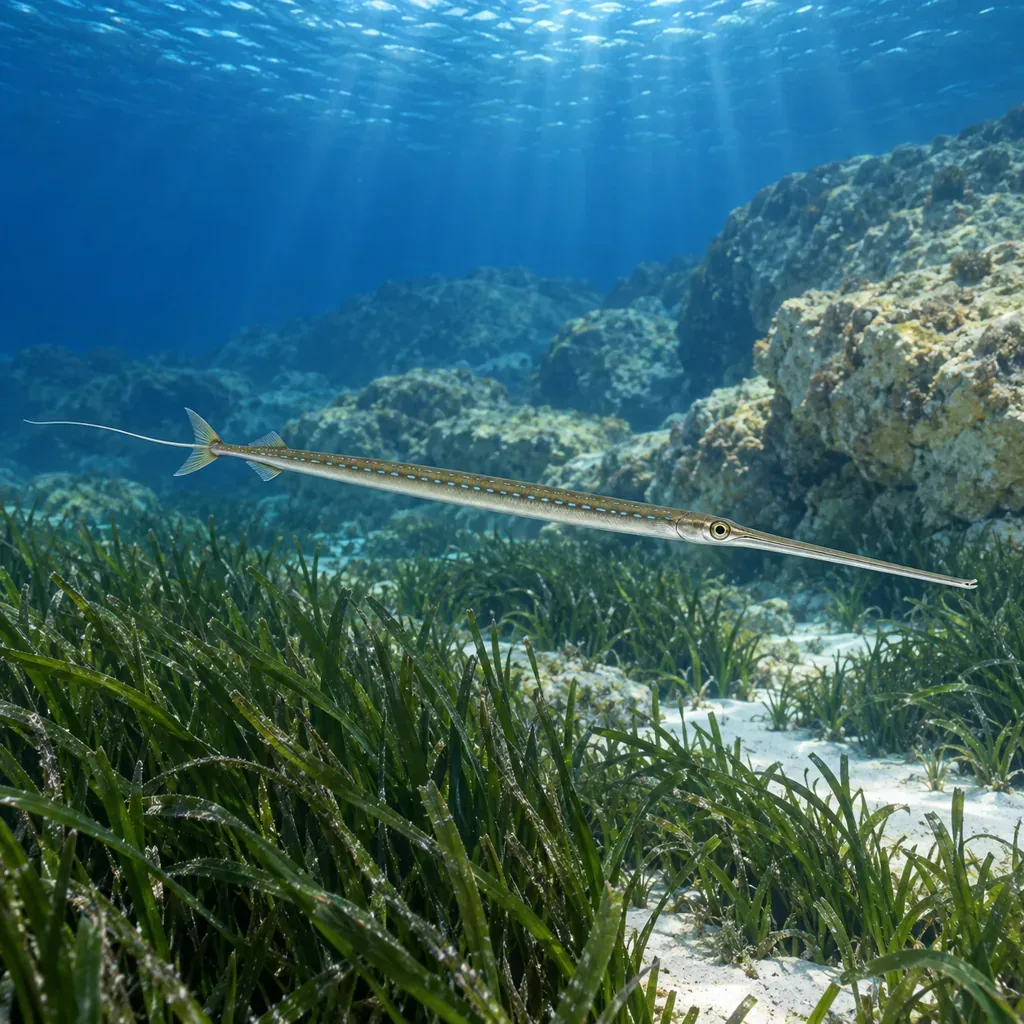
Once you have seen one you cannot mistake it. The body is a long, thin, flattened tube, olive to silvery brown above and pale below, with a long bony snout ending in a small mouth, and a tail that carries a fine trailing filament longer than a diver's finger. Rows or pairs of small pale blue spots run along the back, sometimes joining into faint dashed lines, and the fish can switch its pattern from plain silver to dark banded in seconds. Maltese fish are usually 60 cm to a metre; the maximum is about 1.6 m, mostly tail.
It hovers rather than swims, hanging almost motionless over sand, Posidonia and reef edges, often angled slightly nose-down, and it approaches prey with extraordinary slowness before sucking in a small fish through that pipe of a snout. Divers around Malta and Gozo meet it from a few metres down to about forty, most often over the seagrass and sand margins and along the shallow reef at sites like Cirkewwa, Comino, Dwejra and Xlendi.
It is not a Mediterranean native. Fistularia commersonii came from the Red Sea through the Suez Canal, reached the eastern Mediterranean at the turn of the millennium and crossed the basin faster than any other Lessepsian fish, with the first Maltese record from Xwejni Bay in Gozo in 2005 and regular sightings since. It is now a permanent part of the Maltese fish community, and sightings are still worth reporting to the Spot the Alien Fish campaign.
When to look: Mainly the warm months from June to October in shallow water, though individuals are seen around the islands all year.
Diving with them
- Look for a horizontal line where there should be nothing, it is far easier to spot side-on than head-on
- It will often hold position and let you get quite close, so approach slowly and stop rather than circling
- Photograph it at an angle rather than square on, a head-on shot of a tube is a picture of nothing
- Watch it hunt over seagrass if you have the time, the stalk is almost imperceptibly slow and the strike is instant
- It is worth logging your sighting with the Spot the Alien Fish citizen science campaign, with date, site and depth
- Do not attempt to catch or kill it, there is no local cull programme and a thrashing fish near your gear helps nobody
Can it hurt you?Harmless
Harmless to divers. It has no venom and no spines, the mouth is a narrow suction tube built for small fish, and it will not approach you aggressively.
Easily confused with
- Garfish (Belone belone), the Maltese msella, which has a long beak full of teeth and swims fast at the surface rather than hovering
- Red cornetfish (Fistularia petimba), a deeper-water relative that is reddish and much less often seen
- Trumpetfish, which does not occur in the Mediterranean and is stockier with a shorter snout
- Pipefish, which are far smaller, stiffer-bodied and drift in seagrass rather than over open sand
Further reading: FishBase: Fistularia commersonii, Malta country page and first Maltese record · IUCN MedMIS: Fistularia commersonii Mediterranean invasion · OAR@UM: increasing occurrence of Fistularia commersonii in the central Mediterranean · Atlantis Gozo Diving: bluespotted cornetfish in Maltese waters