🐟 Fish · Labrus mixtus
Cuckoo wrasse
Parpanjolin Maltese
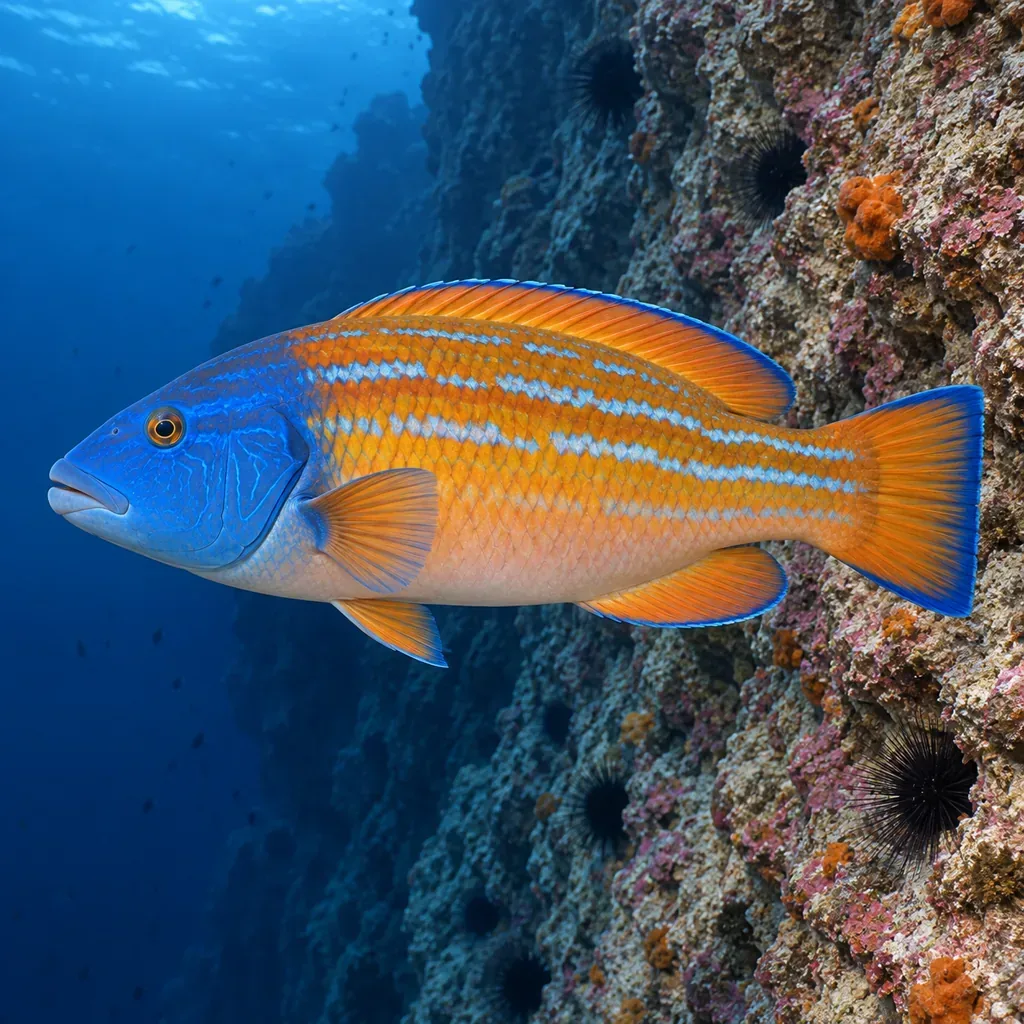
Electric blue male hiding on the deeper rock
Meet the Cuckoo wrasse
A handsome, fairly large wrasse that most Maltese divers only meet once they start going deeper than the usual reef. The two sexes look like different fish. Males have a brilliant blue head with blue streaks running back over an orange-yellow body, and the blue intensifies to something close to electric in the breeding season. Females and young fish are orange-pink to reddish with three distinct black blotches along the upper back near the tail, often separated by white patches.
It is a solitary, slow-cruising fish that works along rock faces and the algal fringe picking crustaceans, small molluscs, worms and the occasional small fish. Males reach about 40 cm and females around 30 cm, with 25 to 30 cm typical for what you actually see.
Around Malta and Gozo it turns up on the deeper walls and boulder slopes, generally from around twenty-five metres down and increasingly common past thirty-five, which puts the good sightings on sites like the Blue Hole outer reef, Ras id-Dawwara and the deeper Comino drop-offs. It grows slowly and does not bounce back quickly from being fished out of a patch of reef.
When to look: All year; males are in their most intense blue in late spring and early summer while nesting.
Diving with them
- Work the deeper rock faces below twenty-five metres rather than the shallow reef
- It is naturally wary - stop finning, breathe long and let it come back to its patrol line
- At depth the blue of the male reads almost black to the naked eye; you need a strobe or a torch to see the real colour
- Females with the three black saddle blotches are easy to write off as a small red bream - check the wrasse profile and thick lips
- Generally solitary, so a female nearby often means a male is somewhere on the same stretch of wall
Can it hurt you?Harmless
Harmless. It is shy of divers and has no spines or venom of any consequence.
Easily confused with
- Brown wrasse (Labrus merula) - same shape but uniformly dark brown-green with no blue head
- Green wrasse (Labrus viridis) - plain green and usually shallower
- Peacock wrasse (Symphodus tinca) - blotchier, shallower and without the blue head or black back saddles
Where to meet them: 1 sites
Further reading: FishBase - Labrus mixtus · Il-Miklem - Parpanjol / Labrus mixtus · Wikipedia - Cuckoo wrasse